It is a question that seems straightforward until you are standing at the base of a ladder looking up at a roofline that is considerably higher than it appeared from the back door. Ku-ring-gai homeowners ask it regularly, and the honest answer is more nuanced than a simple yes or no.
DIY gutter cleaning is not impossible. But in Ku-ring-gai specifically, the combination of property characteristics, native debris volumes and the practical realities of working at height creates a risk profile that is genuinely higher than most homeowners appreciate before they attempt it. Understanding that profile clearly is more useful than a blanket warning, because it allows you to make an informed decision rather than an uninformed one.
Before addressing the safety question directly, it is worth understanding what makes Ku-ring-gai properties specifically more challenging for DIY gutter work than properties in many other parts of Sydney.
Ku-ring-gai homes are not representative of the broader Sydney housing stock. The municipality’s development history, its sandstone ridge and gully topography and its prestige residential character have produced a housing stock that is disproportionately large, complex and elevated compared to the Sydney average.
Many properties across Gordon, Pymble, St Ives, Turramurra, Wahroonga and Killara are built on sloped blocks where the effective height from ground level to gutterline varies dramatically between the street-facing and garden-facing aspects of the same building. A property that looks like a modest single-storey home from the street may present as a full two-storey height at the rear due to the slope of the block.
This is not a theoretical concern. A homeowner who assesses the height of their gutters from the front of the house and selects a ladder accordingly may arrive at the rear of the property and find the gutterline is several metres higher than expected. The assessment that informed the equipment choice was simply wrong.
Beyond height, Ku-ring-gai properties frequently have:
Each of these factors individually increases the risk of DIY gutter cleaning. On a typical Ku-ring-gai property, several of them apply simultaneously.
The safety concern around DIY gutter cleaning is not hypothetical. It is backed by consistent and sobering data from Australian health and safety authorities.
Safe Work Australia’s data on fall-related injuries identifies falls from height as one of the leading causes of serious and fatal injuries in non-workplace settings across the country. Ladder falls specifically are a significant contributor to this category, and household maintenance tasks including gutter cleaning are among the most common activities during which these falls occur.
The Australian Institute of Health and Welfare has reported that fall-related hospitalisations from domestic ladder use result in serious injuries including fractures, traumatic brain injuries and spinal damage at rates that most homeowners significantly underestimate when assessing the risk of climbing a ladder at home.
A fall from gutter height on a standard single-storey Sydney home is a fall of approximately three to four metres. On a two-storey home it is five to seven metres or more. On a sloped block in Ku-ring-gai where the effective rear elevation is greater than the front, these figures can be higher. A fall from any of these heights onto hard ground, landscaping or garden structures carries a high probability of serious injury and a meaningful risk of fatality.
For homeowners who have considered the risk profile and still want to understand what safe DIY gutter cleaning involves in practice, the following covers what is required to approach the task with appropriate preparation.
Safe DIY gutter cleaning requires equipment that most homeowners do not already own and that represents a meaningful upfront cost. Attempting the task with inadequate equipment significantly increases the already elevated risk.
Extension ladder rated to AS/NZS 1892 standards. A domestic stepladder is not appropriate for gutter work on anything other than the most accessible single-storey sections. An extension ladder rated for the height required, with non-slip rubber feet and appropriate weight rating for the user plus equipment, is the starting point. Quality extension ladders appropriate for residential roof work cost $300 to $600 or more.
Ladder standoff or stabiliser. A ladder leaned directly against a gutter puts pressure on the gutter that can cause it to deform, pull away from the fascia or fail under load. A standoff bracket holds the ladder away from the building and distributes the load more safely while improving stability. This is not an optional accessory in a properly equipped DIY setup.
Non-slip footwear with ankle support. Soft-soled shoes or boots with grip appropriate for potentially wet, sloped or debris-covered surfaces. This is not the task for casual footwear.
Work gloves rated for puncture and abrasion resistance. Gutter debris in Ku-ring-gai includes hard seed pods, bark fragments and in some cases wasp nests and possum nesting material. Unprotected hands in a gutter are at genuine risk of cuts, abrasion and in the case of disturbed insects, stings.
Safety glasses. Debris dislodged from a blocked gutter drops downward. Working directly above a gutter trough means eyes are directly in the fall path of whatever comes loose.
Appropriate clothing. Long sleeves and long pants protect against scratches from bark fragments, insect contact and the organic debris that inevitably falls on the person doing the cleaning.
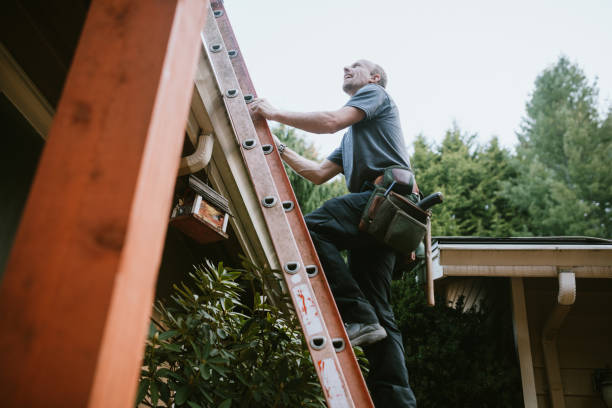
Even with appropriate equipment, ladder technique is where most DIY gutter cleaning injuries originate. The correct technique is not complicated but it requires consistent discipline across an entire job, including when fatigue sets in toward the end.
There are specific circumstances under which DIY gutter cleaning should not be attempted regardless of the homeowner’s general confidence and capability.
In Ku-ring-gai, at least one of these conditions applies to the vast majority of properties.
Beyond the ladder fall risk, which is the most serious and most discussed danger, DIY gutter cleaning in Ku-ring-gai carries several additional risks that are worth understanding.
Ku-ring-gai’s native bushland environment means gutters here contain things that gutters in less vegetated parts of Sydney typically do not.
Wasp and bee nests. Common paper wasps and European wasps both nest in gutters, particularly in debris-filled sections that provide a sheltered, dry environment. Disturbing a nest while working at height is a dangerous situation. A defensive swarm while on a ladder creates exactly the kind of rapid, uncontrolled movement that causes falls.
Possum nesting material. Brush-tail and ring-tail possums both use gutters as nesting sites across Ku-ring-gai. Disturbing a possum nest, particularly one with young present, can result in defensive behaviour from the occupant. Possums have sharp claws and will defend a nest site.
Funnel-web spider habitat. The Australian Museum’s funnel-web spider information notes that Sydney funnel-web spiders are found throughout the Ku-ring-gai area and surrounding northern suburbs. They are attracted to moist, sheltered environments. Gutter debris in Ku-ring-gai, particularly compacted damp organic matter in box gutters and concealed drainage sections, provides exactly this habitat. Reaching blindly into a gutter trough without visual confirmation of what is there is a genuine risk in this environment.
Snake habitat. The bushland adjacent to many Ku-ring-gai properties supports populations of eastern brown snakes and red-bellied black snakes. While direct snake encounter during gutter cleaning is less likely than the other hazards listed, properties with bush interfaces are environments where situational awareness about wildlife is consistently warranted.
The physical demands of gutter cleaning are consistently underestimated by homeowners who have not done it before. On a Ku-ring-gai property with significant native debris accumulation, the task is genuinely strenuous.
Repeatedly climbing and descending a ladder, carrying a bucket of wet compacted debris, repositioning heavy equipment on uneven ground and working with arms raised in awkward positions for extended periods creates physical fatigue that accumulates over the duration of the job. Fatigue is a primary contributor to errors in ladder technique, and a technique error in the final twenty minutes of a two-hour job is just as dangerous as one at the start.
The NSW Health occupational health guidance on musculoskeletal injury identifies overhead work with extended reach as a high-risk activity for shoulder, neck and back injury. The gutter cleaning position, arms raised and reaching laterally from a ladder, creates exactly this loading pattern.
Separate from the safety considerations, there is a practical limitation to what DIY gutter cleaning achieves compared to professional work that is relevant for Ku-ring-gai’s specific debris environment.
The native debris profile in Ku-ring-gai, including compacted gum leaf mats, bark strips, hard seed pods and fine organic silt, requires more thorough treatment than loose suburban leaf debris. A DIY clean that removes surface debris but does not fully flush downpipes, clear compacted silt from the gutter base or identify structural issues leaves a gutter system that looks cleared but is not performing properly.
Downpipe flushing in particular requires equipment and technique that goes beyond what most homeowners can achieve with a garden hose. Ku-ring-gai’s fine native debris accumulates at downpipe inlets and within pipes in ways that resist being cleared by household water pressure.
Pulling together a practical safety framework for Ku-ring-gai homeowners who want to manage their gutter maintenance responsibly, whether they choose DIY or professional services, involves being clear about what each option involves and what it requires.
Before deciding to clean gutters yourself on a Ku-ring-gai property, work through these questions honestly.
If any of these questions produces a no or an uncertain answer, professional cleaning is the appropriate choice for that property.
For the small proportion of Ku-ring-gai properties and homeowners for whom the self-assessment above produces confident yes answers across the board, the practical guidance is:
For the majority of Ku-ring-gai properties, professional gutter cleaning is not just the safer option. It is the more thorough option that actually solves the problem rather than partially addressing it.
For Ku-ring-gai homeowners wanting locally relevant information on professional gutter maintenance services and what they cover for the area’s specific property types and debris conditions, GutterGorilla’s Ku-ring-gai page is the right starting point.
Information on what a professional gutter cleaning service should include and how to evaluate whether a provider is covering the full scope of work required is available on GutterGorilla’s gutter cleaning page.
DIY gutter cleaning in Ku-ring-gai is dangerous for most homeowners on most properties in the area. The sloped blocks, complex rooflines, native wildlife hazards and sheer debris volumes that characterise Ku-ring-gai properties create a risk and workload profile that is genuinely beyond what the task appears to involve from ground level.
The cost of a professional clean is modest. The cost of a ladder fall, ranging from weeks of recovery from a fracture to outcomes that are far more serious, is not. On the specific evidence of where Ku-ring-gai properties sit in the risk spectrum for DIY gutter work, the professional option is not just the easier choice. For most homeowners in this area, it is the only sensible one.