
Homeowners in Ku-ring-gai who have recently moved from other parts of Sydney often say the same thing: they had no idea how quickly gutters could fill up until they moved here. What felt like a manageable once-a-year task in a less vegetated suburb becomes a recurring and surprisingly urgent maintenance issue in Gordon, Pymble, St Ives, Turramurra, Wahroonga and the surrounding areas.
The speed at which gutters fill in Ku-ring-gai is not imagined and it is not bad luck. It is the direct result of a specific set of environmental conditions that make this part of Sydney one of the most demanding gutter maintenance environments in the entire metropolitan area.
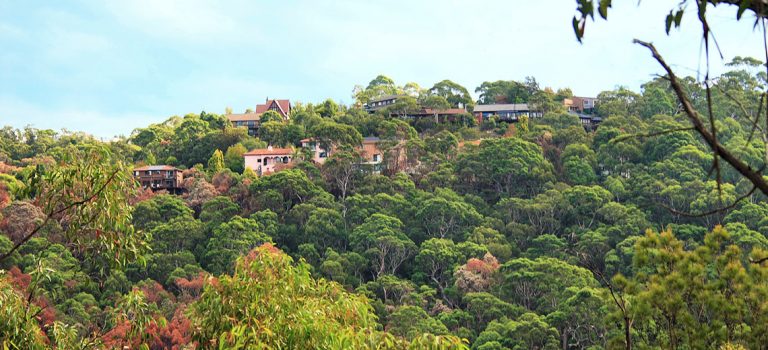
To understand why Ku-ring-gai gutters fill so quickly, you need to start with the landscape itself. Ku-ring-gai is not a suburb that happens to have some trees. It is a municipality that was developed within and around a native bushland environment that still defines the character of virtually every street and property in the area.
Ku-ring-gai Chase National Park borders the municipality directly to the north and east, and large tracts of bushland are woven through the residential fabric of the area itself. This is not background greenery. It is an active, continuous source of organic debris that affects every property within falling and wind-drift distance of native vegetation.
The dominant species in and around Ku-ring-gai are eucalypts in various forms, angophoras, banksias, scribbly gums, Sydney peppermints and a range of proteaceous understorey species. These plants do not follow a seasonal shedding schedule. They shed leaves, bark, seed capsules, flower heads and fine organic dust across every month of the year in quantities that reflect their maturity and density.
The Office of Environment and Heritage NSW describes the Sydney Turpentine-Ironbark Forest and associated bushland communities found in Ku-ring-gai as among the most ecologically significant in the Sydney basin, with canopy trees reaching maturity over decades and producing substantial ongoing litter fall. That ecological significance translates directly into a gutter maintenance challenge for the homeowners who live beneath and alongside that canopy.
Not all leaf debris behaves the same way in gutters, and eucalyptus leaves are among the most effective at creating fast, dense blockages.
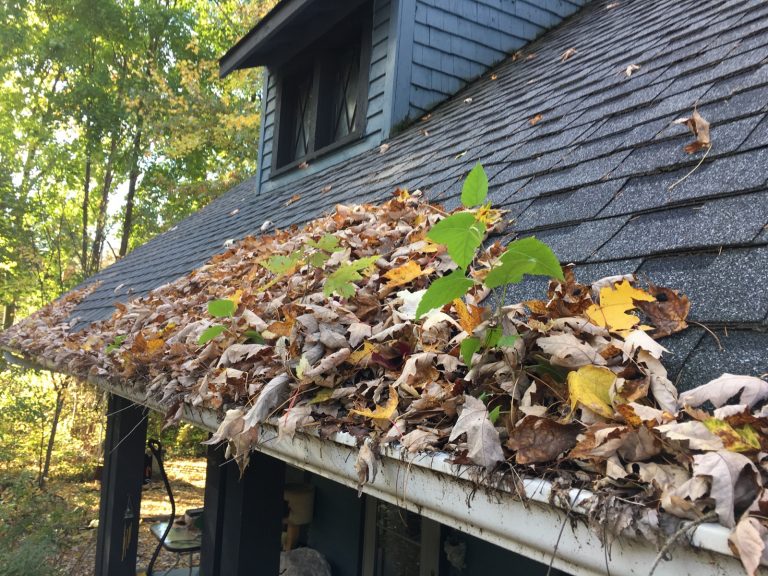
Gum leaves are long, narrow and fibrous. When they land in a gutter they lie flat and orient themselves along the length of the trough. Each leaf that settles adds to a layer that is already flat and dense rather than creating air gaps the way crinkled deciduous leaves sometimes do. The result is a compact mat that builds efficiently and resists being moved by water flow once it reaches a certain thickness.
This layering behaviour means that a eucalyptus-affected gutter can go from clear to significantly blocked within two to three weeks of a heavy shedding event. Unlike an autumn leaf fall from a deciduous tree, where the bulk of the debris arrives and settles in a single period, eucalyptus shedding is continuous and unpredictable, which means there is no clear seasonal window where Ku-ring-gai gutters can be expected to stay clean.
Eucalyptus and angophora bark shedding is a year-round event in Ku-ring-gai, and it creates a specific type of gutter blockage that goes beyond what most homeowners expect.
Bark strips range from small, papery flakes to large, rigid sections that can be half a metre long or more. A large bark strip landing across a gutter can bridge the full width of the trough, creating a platform that subsequently catches leaves, seed pods and fine debris on top of it. Rather than a gutter filling from the bottom up with loose material, bark creates an elevated dam that blocks water flow while the gutter appears relatively empty beneath it.
This explains a frustrating experience that many Ku-ring-gai homeowners have had: a gutter that was cleaned recently appears clear from the ground but overflows dramatically at the next rain event. In many cases, a bark strip or two has landed since the last clean and is diverting water over the edge rather than through the downpipe.
Beyond the primary native vegetation factor, several additional causes contribute to the speed at which Ku-ring-gai gutters fill and block.
Ku-ring-gai sits on elevated sandstone country with a varied topography of ridges, gullies and slopes. This topography channels wind in ways that move debris from surrounding bushland onto rooftops more efficiently than flat terrain would.
Properties on ridge lines face prevailing north-easterly breezes that carry fine native debris from the national park corridor across rooftops and into gutters. Properties in gully positions collect wind-channelled debris from multiple directions and often receive material from properties higher up the slope as well as from directly adjacent vegetation.
The combination of natural wind patterns and complex topography means that Ku-ring-gai properties receive debris not just from trees directly overhead but from a much wider surrounding area. A property with no large trees immediately adjacent to the roofline can still experience significant gutter accumulation from wind-carried debris originating from nearby bushland.
The native vegetation of the Ku-ring-gai area produces a range of debris types beyond leaves and bark that collectively contribute to fast gutter filling.
Banksia flower cones, when they dry and break apart, produce both a hard woody core and a mass of fine fibrous material. Grevillea flower heads drop continuously through their flowering period. Sydney peppermint and other small-leafed species produce enormous quantities of fine leaf material that is easily wind-carried and settles into gutter profiles readily.
Perhaps most significantly, native bushland produces large quantities of fine organic dust from pollen, decomposing material and airborne particulates. This material settles into gutters as a fine layer at the base of any existing debris, creating a silt-like substrate that resists flushing and reduces the effective internal depth of the gutter over time. A gutter that looks relatively clear of visible debris may have a centimetre or more of fine compacted silt at its base that significantly reduces its drainage capacity.
The speed at which Ku-ring-gai gutters fill is not simply a function of leaf volume. It is the compound effect of multiple debris types arriving continuously, each with different physical characteristics that interact with each other in the gutter trough.
Leaves create the foundation mat. Bark strips create elevated dams. Seed pods create hard blockages at downpipe inlets. Fine organic dust fills the spaces between larger debris and creates the silt layer. Each type reinforces the blockage effect of the others, and together they produce the fast fill rates that characterise Ku-ring-gai gutters.
The CSIRO’s research into urban vegetation and building maintenance impacts has noted that properties adjacent to mature native bushland experience measurably higher rates of roof and gutter maintenance requirements than those in less vegetated urban environments, which aligns directly with what homeowners across Ku-ring-gai observe in practice.
Ku-ring-gai’s native bushland supports one of the highest densities of wildlife of any urban municipality in Australia. Ring-tail and brush-tail possums are abundant across the area, and they use roof spaces and gutters extensively as travel corridors and nesting sites. A possum nest in a box gutter or at a downpipe inlet can create a complete blockage almost overnight and is significantly more difficult to address than standard leaf debris.
Bird activity also contributes. Currawongs, cockatoos, rosellas and various honeyeater species common throughout Ku-ring-gai drop debris into gutters as they forage and perch in adjacent trees. Bird droppings are acidic and contribute to surface degradation in gutters over time alongside the physical blockage contribution of nesting material.
Given the speed at which gutters fill in Ku-ring-gai, the maintenance approach needs to reflect the actual debris cycle of the area rather than a generic Sydney schedule.
This is the question that most Ku-ring-gai homeowners get wrong initially. The answer depends on the specific property but for most homes in the municipality, twice per year is the minimum and many properties require three to four cleans annually to stay genuinely ahead of blockage risk.
Properties with large eucalypts or angophoras directly overhead, properties in gully positions that collect wind-channelled debris, and properties with box gutters or concealed drainage systems should be treated as higher frequency requirements from the outset rather than after an overflow event has demonstrated the need.
The most useful timing for Ku-ring-gai properties follows the area’s debris cycle rather than the calendar seasons.
Standard surface cleaning is not sufficient for gutters in Ku-ring-gai’s native bushland environment. A professional service on a property in this area should cover the following.
Understanding the specific factors that contribute to overflow in Ku-ring-gai, as distinct from general gutter blockage, helps homeowners make better decisions about maintenance priorities and property management.
Overflow in Ku-ring-gai residential properties tends to have specific characteristics that reflect the area’s housing stock and environmental context.
Many Ku-ring-gai homes are large properties on generous blocks with complex roof designs. Multiple roof planes, valleys, dormers and architectural features create multiple gutter runs, multiple downpipes and multiple potential blockage points. A blockage in one section of a complex roof drainage system may not be visible from the ground and may only reveal itself during a significant rainfall event when the backed-up water has nowhere to go except over an edge or through the building fabric.
Properties in the area also commonly have mature landscaping that obscures gutters from ground-level observation, making casual monitoring harder than on a simpler property. The combination of complex roofs, substantial vegetation and difficult visual access means that Ku-ring-gai properties benefit particularly from professional inspections that involve actual access to the gutterline rather than ground-level assessment alone.
The continuous moisture contact from fast-filling gutters in Ku-ring-gai has specific structural consequences that play out over a typical property’s maintenance history.
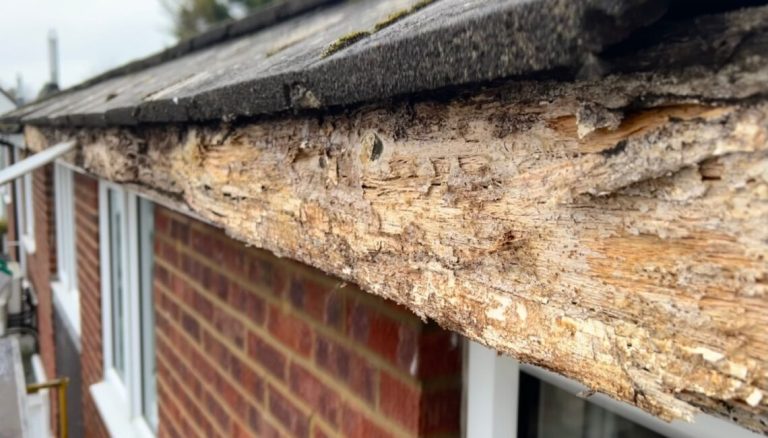
The constant wet-dry cycling of a gutter that regularly fills with moist native debris accelerates the deterioration of timber fascia boards faster than intermittent overflow in a less vegetated suburb. Ku-ring-gai properties that have not been maintained on an adequate schedule consistently show earlier and more extensive fascia deterioration than comparable properties in other parts of Sydney, according to building maintenance professionals working in the area.
The Australian Building Codes Board’s guidance on moisture management in building envelopes identifies the roof-to-wall junction as one of the highest-risk points for moisture ingress in residential buildings, and the fascia-gutter interface in Ku-ring-gai’s demanding debris environment represents exactly this risk in an active and ongoing way.
Ku-ring-gai is consistently among the highest-value residential property markets in Sydney. The combination of large blocks, leafy streetscapes and proximity to quality schools and amenities supports property values that reflect the area’s desirability.
That value context makes the maintenance investment calculation straightforward. A property worth $3 million or more that suffers avoidable water damage from neglected gutters faces repair costs that are significant in absolute terms and that affect the condition and value of an asset that represents a substantial portion of the owner’s wealth. The cost of appropriate maintenance is trivial relative to both the asset value and the repair costs it prevents.
For Ku-ring-gai homeowners wanting local information on professional gutter maintenance services and what the area’s specific conditions demand, GutterGorilla’s Ku-ring-gai page provides relevant local detail on services and approach.
Homeowners looking for broader context on professional gutter maintenance standards and what a thorough service should involve can find that on the GutterGorilla website.
It is worth being direct about this: gutters in Ku-ring-gai are not filling up quickly because homeowners are doing something wrong. They are filling up quickly because the environment demands it. The native bushland, the continuous debris cycle, the wind patterns and the wildlife activity all contribute to a maintenance reality that is simply more demanding than most other parts of Sydney.
The appropriate response is not frustration but a maintenance schedule that reflects what the environment actually requires. For most Ku-ring-gai properties, that means professional cleaning three times per year as a starting point, with adjustments based on specific tree coverage and roof configuration.
The homeowners who stay ahead of it find it a manageable part of looking after a property in one of Sydney’s most beautiful and desirable areas. The ones who try to apply a once-a-year approach tend to find out the hard way what fast-filling gutters eventually cost when they are left to their own devices.