Solar panels in Ku-ring-gai face a contamination environment unlike almost anywhere else in metropolitan Sydney. The combination of continuous native vegetation debris, abundant wildlife, elevated UV exposure and proximity to Ku-ring-gai Chase National Park creates conditions where panel soiling happens faster, accumulates more densely and causes more significant output losses than in less vegetated parts of the city.
Most homeowners with solar in Ku-ring-gai know the panels need occasional attention. Far fewer understand what is actually happening to their system’s performance in the months between cleans, or what the cumulative cost of that neglect adds up to over a year.
To understand the impact of not cleaning solar panels in Ku-ring-gai, it helps to start with what is actually landing on those panels and why the local environment makes this a more pressing issue than the generic advice about solar maintenance suggests.
Ku-ring-gai’s native bushland environment produces a debris and contamination profile that is qualitatively different from what solar panels experience in suburban Sydney environments dominated by introduced species or light urban pollution.
Eucalyptus and native tree debris. The municipality is dominated by mature eucalypts, angophoras, scribbly gums, banksias and a range of proteaceous native species. These plants shed leaves, bark dust, pollen, seed capsules and fine organic material continuously across every month of the year. Unlike deciduous species that shed in a single autumn period and then stop, native vegetation in Ku-ring-gai produces airborne debris in every season without pause.
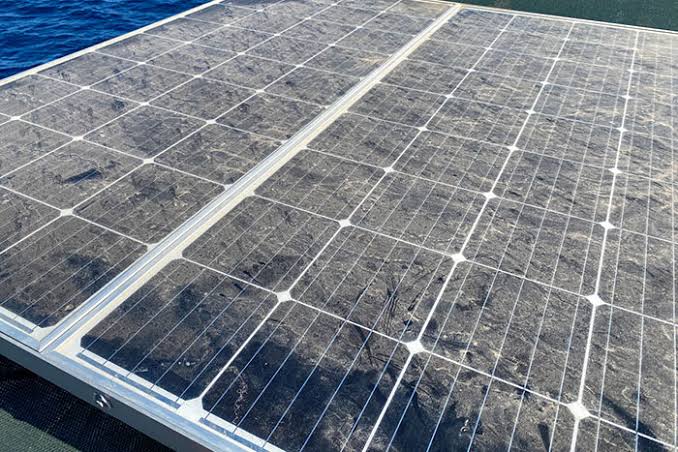
This material settles on solar panel glass surfaces where it combines with moisture from dew and light rain to form a sticky organic film. The film does not simply sit on the glass waiting to be washed away. It bonds to the surface through repeated wet-dry cycling as dew forms overnight and evaporates during the day, becoming progressively harder to remove with each cycle.
Pollen loads. Ku-ring-gai’s native vegetation produces significant pollen loads, particularly during spring when multiple species flower simultaneously. Pollen is fine, light and highly adhesive. It settles on panel surfaces in quantities that are not visible to the naked eye but are measurable in their effect on light transmission. The Australian Institute of Botany has documented the exceptionally high native plant diversity of the Sydney sandstone region that encompasses Ku-ring-gai, and that diversity translates into an extended pollen season with multiple species contributing across most of the year.
Bird and possum activity. Ku-ring-gai supports one of the highest densities of native wildlife of any residential municipality in Australia. Rooftop solar panels are frequently used as perching, basking and travel surfaces by both birds and possums. The resulting droppings are among the most performance-damaging contaminants for solar panels, not just because they block light but because of how they interact with the panel circuitry below.
Fine atmospheric particulates. Despite its leafy, suburban character, Ku-ring-gai is not isolated from Sydney’s broader atmospheric pollution load. Prevailing westerly winds carry fine particulate matter from the greater Sydney basin across the northern suburbs. This urban pollution component combines with the native organic debris to create a composite contamination layer that is more adhesive and harder to remove than either source alone.
A common assumption among solar panel owners across Sydney is that rainfall provides adequate natural cleaning. In Ku-ring-gai, this assumption is particularly unreliable.
Ku-ring-gai receives reasonable annual rainfall, but the rain in this area carries its own contamination load. Rainwater passing through the native tree canopy picks up dissolved organic compounds, fine debris and biological material before it reaches the roof. Rather than delivering clean water to the panel surface, rain in a heavily vegetated environment like Ku-ring-gai often deposits additional contamination alongside whatever it partially removes.
Light rain events followed by rapid drying are actively counterproductive. The water partially dissolves surface deposits, then evaporates and leaves a concentrated residue behind. Each light rain event without a thorough flush can leave panels in a marginally worse condition than before the rain, which is the opposite of what most homeowners assume is happening.
The practical consequences of not cleaning solar panels in Ku-ring-gai play out across several dimensions, from immediate output loss through to longer-term degradation effects that affect the system’s value over its full lifespan.
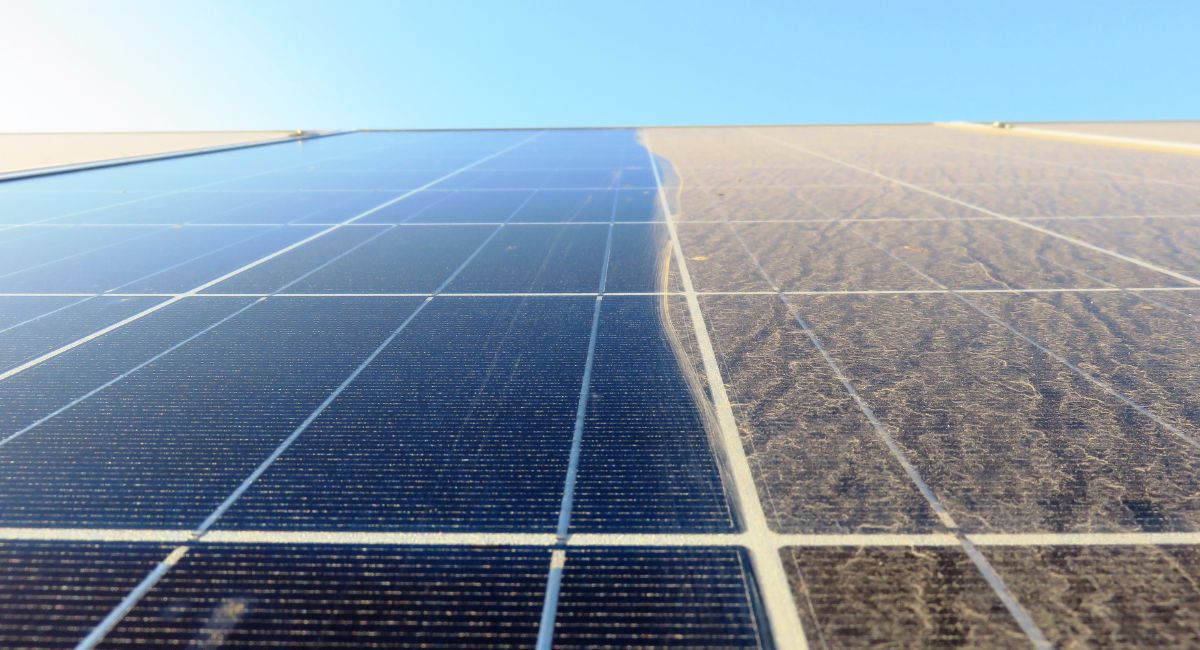
Research into solar panel soiling losses in Australian environments consistently shows output reductions in the range of 5 to 25 percent for panels that go without professional cleaning over extended periods. The Australian Renewable Energy Agency has identified soiling as one of the most underestimated factors affecting residential solar system performance in urban and peri-urban environments, noting that losses in vegetation-rich areas tend toward the higher end of documented ranges.
For Ku-ring-gai properties, the combination of organic debris, pollen, bird activity and atmospheric particulates places most unclean systems toward the middle to upper end of that range. A system experiencing 15 percent soiling loss is not producing 15 percent less power on a few bad days. It is producing 15 percent less power every single day until the panels are cleaned.
For a 6.6kW system in Ku-ring-gai producing an average of around 25 kilowatt-hours per day under clean conditions, a 15 percent soiling loss represents approximately 3.75 kilowatt-hours of lost generation daily. At current NSW electricity rates and feed-in tariff levels, that daily loss translates to somewhere between $1.10 and $1.80 per day depending on how the household uses that generation.
Across a full year, the financial loss from a 15 percent soiling rate on a single 6.6kW system sits in the range of $400 to $660. For larger systems in the 10kW range that are increasingly common on Ku-ring-gai’s larger properties, the annual loss scales proportionally and can comfortably exceed $800.
Of all the contamination sources affecting Ku-ring-gai solar panels, bird droppings deserve specific attention because their impact is disproportionate to their physical size.
Modern solar panels are constructed with individual cells wired together in series strings. When one cell in a string is partially or fully shaded, the output of the entire string is suppressed to match the weakest cell. This is the bypass diode principle that governs panel circuitry, and it means that a single bird dropping covering a small area of one cell can drag down the output of an entire string containing many more cells.
In Ku-ring-gai, where rooftop panels are regularly used as perching surfaces by currawongs, cockatoos, kookaburras and a range of other native species, multiple concentrated deposits across different strings of an array are the norm rather than the exception on panels that have not been recently cleaned.
The Clean Energy Council’s guidance on solar system performance monitoring notes that string-level output suppression from concentrated soiling deposits is one of the most common causes of performance shortfalls that do not appear as faults in standard inverter monitoring. The system registers as operational because it is producing power, but it is producing significantly less than it should because of deposits that appear minor from the ground.
Beyond the immediate output loss from surface contamination, there is a longer-term consequence of extended cleaning neglect that affects the permanent performance capability of the panels themselves.
Solar panel glass is typically coated with an anti-reflective treatment that increases light transmission into the cells below. This coating is designed to be durable but is not indestructible. Acidic contamination from bird droppings, combined with the mild acidity of decomposed organic material from native vegetation, can etch or degrade this coating over extended contact periods.
Once the anti-reflective coating is degraded, the panel’s light transmission capability is permanently reduced regardless of how clean the glass surface subsequently becomes. This means that extended cleaning neglect in Ku-ring-gai’s contamination-heavy environment can result in permanent performance loss rather than temporary soiling that is fully reversible with cleaning.
The Australian Consumer Law provisions on product guarantees apply to solar panels, but manufacturer warranties typically include reasonable maintenance requirements as conditions of the performance guarantee. A claim for panel degradation on a system that cannot demonstrate a maintenance history may be assessed differently to one with documented regular cleaning.
Moving from the performance loss to the practical experience of a Ku-ring-gai homeowner whose panels have not been cleaned, the signs of neglect are identifiable if you know what to look for.
The deterioration of an uncleaned solar system in Ku-ring-gai follows a predictable pattern.
In the first two to three months after a clean, contamination begins accumulating but output loss is modest. Most homeowners do not notice anything at this stage because the change is within the normal variation from weather and seasonal factors.
By six months, contamination has compacted into a more adhesive layer and fine organic silt from native vegetation has settled into the lower sections of panel surfaces. Output loss is measurable at this point, typically in the 8 to 12 percent range for a Ku-ring-gai property, but still easy to rationalise as seasonal variation.
By twelve months without cleaning, the composite contamination layer is well established. Fine debris has been wet and dried dozens of times, bird droppings have accumulated across multiple strings and the organic film has bonded to the glass surface in a way that rain cannot address. Output loss at this stage is typically 15 to 20 percent or more on a Ku-ring-gai property.
Beyond twelve months, the rate of additional loss from further contamination slows somewhat as the surface approaches a saturation state, but the accumulated loss remains and the risk of anti-reflective coating degradation from persistent acidic contact increases.
Most modern inverter systems provide output data that homeowners can access through an app or web portal. This data contains the evidence of soiling loss, but it is rarely interpreted in a way that prompts action.
The most useful comparison is daily or monthly output against the same period in previous years. A Ku-ring-gai system producing 20 percent less in October 2026 than it did in October 2025, with no change in the household’s consumption patterns or any identified system fault, is almost certainly showing the signature of accumulated soiling loss rather than a hardware problem.
It is worth being direct about what extended neglect costs a Ku-ring-gai solar system owner over a multi-year period.
A homeowner who installs a 6.6kW system and cleans it once in the first three years, compared to one who cleans it annually, faces a cumulative financial gap that compounds each year the system runs below capacity. At a conservative average soiling loss of 12 percent across the three-year period and a financial value of $500 per year for that loss, the total cost of two missed annual cleans is approximately $1,000 in lost generation value, against a cleaning cost of $220 to $320 per service that would have prevented it.
Over a full ten-year period without adequate cleaning, the cumulative loss from soiling on a Ku-ring-gai system is substantial and significantly exceeds the total cost of the maintenance program that would have prevented it.
Understanding what appropriate maintenance looks like for Ku-ring-gai solar panels, and what a professional cleaning service should actually involve, gives homeowners a practical framework for protecting their investment.
For most Ku-ring-gai properties, two professional cleans per year is the appropriate baseline. The specific frequency depends on several factors.
Properties with large native trees directly overhanging or adjacent to the roof, significant bird activity, or panels installed at low angles that do not benefit from any rain-assisted self-cleaning warrant two cleans per year as a minimum. A spring clean before the highest-sunlight summer months and an autumn clean addressing the accumulated debris from warmer months covers the two most impactful windows.
Properties with moderate tree coverage in less densely vegetated parts of Ku-ring-gai may manage adequately with a single annual clean, provided monitoring data does not show faster performance decline between services.
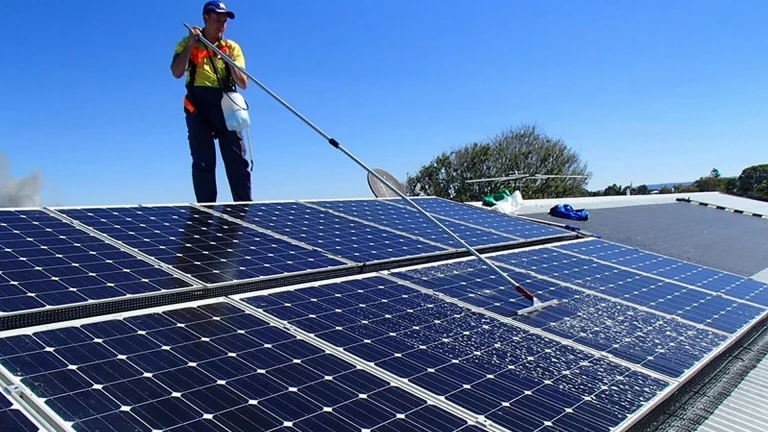
A professional solar panel cleaning service on a Ku-ring-gai property should be more thorough than a basic rinse, given the adhesive nature of the organic and pollen contamination typical in this environment.
The choice of water type is not a minor detail. Mains tap water in Sydney contains dissolved minerals that deposit on panel surfaces as the water evaporates, potentially leaving a residue layer that worsens surface contamination rather than addressing it. Deionised water leaves no residue and is the correct choice for panel cleaning.
For Ku-ring-gai homeowners wanting to understand what professional solar panel cleaning involves for their specific area and property type, GutterGorilla’s Ku-ring-gai page provides locally relevant service information.
Full detail on what a professional solar panel cleaning service should cover, including the equipment, technique and inspection scope involved, is available on GutterGorilla’s solar panel cleaning page.
Most Ku-ring-gai homeowners paid between $6,000 and $15,000 to install their solar system. That investment was made to reduce electricity costs, generate feed-in income and reduce environmental impact over a twenty-five year system life.
What erodes the return on that investment is not dramatic failure. It is the quiet, cumulative drain of contamination building on panel surfaces month after month in one of Sydney’s most demanding debris environments. The panels keep working. They just work progressively less well than they should, and the gap between what they produce and what they could produce grows wider with every season that passes without a proper clean.
In Ku-ring-gai, where the native environment ensures that gap opens faster than almost anywhere else in Sydney, the case for regular professional cleaning is one of the clearest financial decisions a solar panel owner can make.