Most homeowners understand that blocked gutters cause overflow and that overflow causes water to run down external walls. The link between blocked gutters and foundation damage is less commonly made, and yet it is one of the most financially consequential connections in residential property maintenance.
In Western Sydney, where a significant proportion of homes sit on reactive clay soils, where storm rainfall intensity is high, and where an ageing housing stock means drainage systems are often already operating below peak capacity, the pathway from blocked gutter to foundation problem is shorter and more direct than many homeowners realise.
This article explains that pathway, what the damage looks like, and what Western Sydney homeowners can do to interrupt the cycle before it becomes an expensive structural problem.
To understand how blocked gutters damage foundations, it helps to understand what foundations are designed to do and what conditions they are designed to resist.
Most residential construction in Western Sydney uses either a concrete slab-on-ground foundation or a strip footing and timber subfloor system. Both types are designed to distribute the weight of the building over a stable soil base and to resist the lateral and uplift forces that soil movement can exert on the structure.
Foundation design in Australia accounts for the reactive behaviour of the soil on the site. Reactive soils, particularly the expansive clay soils common across much of the Cumberland Plain and the broader Western Sydney basin, change volume significantly when their moisture content changes. They swell when wet and shrink when dry. Foundation design for these sites specifies depth, reinforcing, and configuration that accommodates a defined range of soil movement based on a modelled moisture profile.
The critical assumption in that model is that soil moisture adjacent to the foundation is not subject to extreme, localised, or sustained variation beyond what normal weather patterns produce. When blocked gutters direct concentrated overflow consistently against the base of the building, that assumption breaks down.
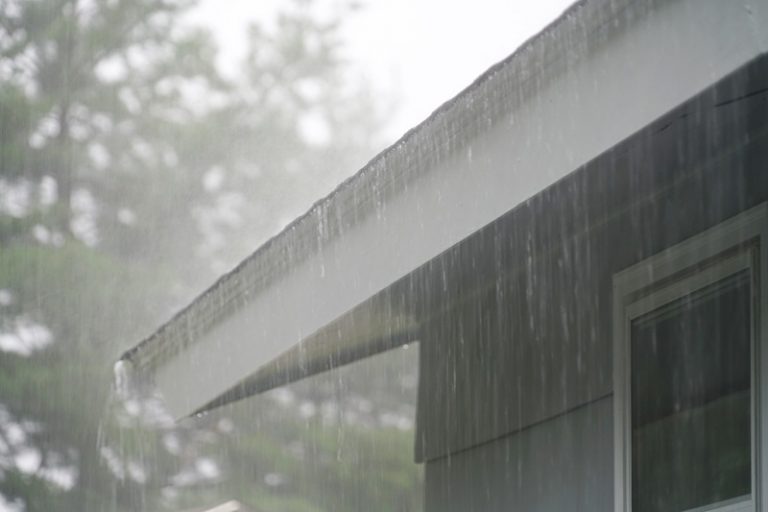
Blocked gutters overflow during rain events. That overflow falls from roofline height onto the ground immediately adjacent to the external wall. Depending on the volume and duration of the overflow, this can deliver a very significant volume of water to a small area of ground next to the foundation in a short period.
This localised saturation creates a zone of elevated soil moisture immediately adjacent to the foundation perimeter. In reactive clay soils, elevated moisture causes soil expansion. Where the soil expands against a rigid foundation structure, it exerts upward and lateral pressure. Where it expands unevenly, because overflow is concentrated at one corner or one section of the building while the rest of the foundation base remains at normal moisture levels, it creates differential movement.
Differential movement is the specific mechanism that damages concrete slabs and strip footings. A foundation that moves uniformly in response to uniform soil conditions maintains its structural integrity. A foundation where one section moves significantly more than adjacent sections experiences bending stress that can cause cracking in the slab or footing, which then becomes a pathway for further moisture penetration and accelerated deterioration.
The reactivity of soil is classified in Australia using the Shrink-Swell Index, and the soils across much of Western Sydney, particularly the Blacktown clays and other alluvial and residual clay profiles common in the Cumberland Plain, are classified as highly reactive. AS 2870, the Australian standard for residential slabs and footings, uses site classification to specify appropriate foundation design for different reactive soil types.
A highly reactive site requires a more robust foundation design than a moderately reactive one. But even a correctly designed foundation for a highly reactive site has limits. If soil moisture variation at the foundation perimeter is significantly greater than the design assumption, the foundation experiences conditions it was not engineered to accommodate.
The actual damage that results from foundation stress driven by blocked gutter overflow takes several forms, each with different implications for repair cost and structural consequence.
Concrete slab cracking is the most common visible consequence of foundation movement. Cracks typically appear at the weakest points in the slab geometry, including re-entrant corners at doorways and window openings, along the line of plumbing penetrations, and in any areas where reinforcing coverage is thinner than specified.
Hairline cracks in a concrete slab do not necessarily indicate structural failure. They are a normal response to some degree of differential movement. But cracks that are wider than approximately two millimetres, that show vertical displacement between the two faces, or that are growing over time indicate ongoing movement that is exceeding the tolerance of the slab design. These cracks require professional assessment rather than cosmetic filling.
Foundation movement that is significant enough to stress the slab will also stress the wall framing and masonry above it. Diagonal cracking at window and door corners, steps cracking in brickwork that follows mortar joints, and render cracking that follows a diagonal pattern are all common visual signatures of foundation movement below.
Wall cracking that appears or grows after rain events, then stabilises during dry periods, is a particularly telling pattern because it suggests a moisture-driven foundation movement cycle that corresponds to seasonal rainfall rather than to a one-time settlement event.
As foundation movement alters the geometry of the building frame, doors and windows that previously operated correctly can begin to stick, jam, or fail to latch. This is a functional symptom that homeowners often notice before visible cracking appears, and it is a useful early indicator that the building geometry is being affected by foundation behaviour.
Doors that stick in summer and free up in winter, or vice versa, may simply reflect timber expansion and contraction. Doors that progressively worsen over months regardless of season, particularly in combination with any wall cracking, are a more concerning sign.
In homes with timber subfloor construction, overflow from blocked gutters that reaches the ground near the building perimeter can migrate beneath the floor slab or through the soil to affect the subfloor environment. Persistent moisture in a timber subfloor space creates conditions for timber decay, mould growth, and pest activity including termites, which are attracted to damp, decaying wood.
Western Sydney has a significant termite risk profile, and moisture maintained in the subfloor space by ongoing overflow from blocked gutters is one of the conditions that increases termite access and activity risk.
Preventing foundation damage from blocked gutters requires addressing the root cause: keeping the gutter and downpipe system functioning correctly so that stormwater is directed away from the building rather than deposited against it.
The standard guidance of two gutter cleans per year is a minimum for most Australian residential properties. For Western Sydney homes with significant native or exotic tree cover, three or more cleans per year may be appropriate. The most important clean is the one carried out before storm season in September or October, when the system needs to be at its maximum drainage capacity before the summer storms arrive.
A clean that removes debris from the gutter channel but does not flush the downpipes is incomplete. Fine sediment accumulates inside downpipes over time and reduces their hydraulic capacity without being visible from above. Including a pressurised downpipe flush in every maintenance visit ensures the full drainage system is clear, not just the surface.
The discharge point of each downpipe should direct water at least 500 millimetres away from the building foundation. Check that downpipe outlets and any connected stormwater pits are not discharging against the wall or into ground that slopes back toward the foundation.
If ground drainage around the building perimeter is flat or slopes toward the structure, even a correctly functioning gutter system will concentrate moisture at the foundation. Addressing ground grading at the same time as gutter maintenance ensures that the water the gutter system correctly moves off the roof is then effectively directed away from the building at ground level.
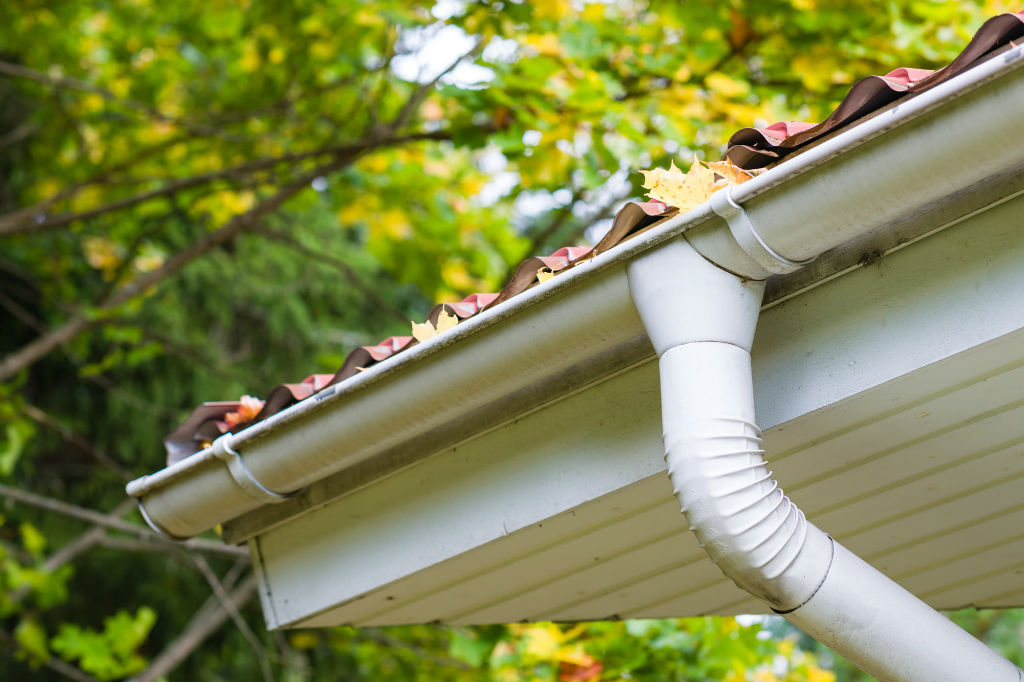
A gutter that is sagging, has lost pitch, or has a corroded joint that leaks rather than draining to the downpipe is delivering water to the wrong location even when it is debris-free. Regular inspection of the gutter system for structural integrity, not just debris loading, is an important part of preventing overflow.
Signs of a gutter system that is not managing water correctly include:
Early identification of foundation movement allows intervention before the damage escalates. Homeowners in Western Sydney should check periodically for:
Any of these signs warrants a conversation with a structural engineer or licensed builder before the issue progresses further.
Bringing together the causal pathway, the damage types, and the prevention approach provides a complete picture of what homeowners are dealing with and what effective management looks like.
Gutter maintenance is one of the most cost-effective investments available in residential property management when assessed against the risks it mitigates. Consider the cost comparison:
A professional gutter clean including downpipe flushing for a standard Western Sydney property costs a few hundred dollars and should be carried out twice to three times per year. Across five years, that represents a maintenance expenditure in the low thousands.
Foundation crack assessment by a structural engineer, followed by underpinning or pier installation to address movement-related foundation damage, represents an expenditure that commonly runs to tens of thousands of dollars for even moderately affected properties. Slab rectification in more serious cases, or the full replacement of a compromised slab section, can exceed this significantly.
The ratio between prevention cost and rectification cost is one of the clearest financial cases in residential maintenance. The problem is that foundation damage develops slowly enough that the connection to the blocked gutter system that initiated it is not always obvious to the homeowner, which is why the prevention investment often does not feel urgent until the consequences become undeniable.
Not all Western Sydney properties face equal foundation risk from gutter overflow. The risk is highest for properties that combine multiple factors:
For properties that combine several of these factors, the case for treating gutter maintenance as a high-priority activity rather than a periodic convenience is particularly strong.
For Western Sydney homeowners looking for more information on local gutter and roof maintenance services, the Western Sydney page provides details on what professional maintenance and drainage inspection services are available in the region.
For more articles on gutter maintenance, drainage problems, and related topics covering the full range of risks associated with poorly managed roof drainage, the Gutter Gorilla blog provides ongoing guidance for Australian homeowners.
Blocked gutters and foundation damage in Western Sydney are connected by a well-understood causal chain that runs through overflow, localised soil saturation, reactive clay expansion, and differential foundation movement. The connection is not dramatic or sudden. It develops over months and years of repeated overflow events, each one adding incrementally to a moisture imbalance that the foundation was not designed to accommodate. Addressing the gutter system that initiates this process is the most direct, most cost-effective, and most practically accessible intervention available to homeowners who want to protect the structural integrity and value of their property.