It is a question that most North Shore homeowners have not thought to ask. Gutters filled with leaves get associated with overflow, water damage and blocked downpipes. The connection to bushfire risk is less obvious, but it is real, well-documented and directly relevant to a part of Sydney where the combination of mature native tree canopy and proximity to bushland creates conditions that fire authorities take seriously.
The short answer is yes. Leaf-filled gutters do make homes more vulnerable to bushfire. And on the North Shore, where suburbs like Wahroonga, Turramurra, Gordon, Pymble, Killara and St Ives back onto or sit within reach of national park and bushland corridors, the implications of that answer are worth understanding clearly.
The North Shore is one of Sydney’s most prestigious and leafy residential corridors. It is also a part of the city where a significant number of properties are classified as bushfire-prone land under NSW Planning’s mapping framework. Ku-ring-gai Chase National Park borders the northern end of the corridor directly, and scattered remnant bushland, gully vegetation and large private gardens with established native trees create fuel connectivity between the national park and residential streets throughout the area.
The North Shore’s elevated bushfire risk relative to most of inner or western Sydney comes from the intersection of several factors that individually are manageable but together create a meaningful hazard.
Native vegetation density. The North Shore’s character is defined by its tree canopy, and that canopy is predominantly native or includes large numbers of naturalised species that behave similarly to native vegetation in fire conditions. Eucalypts, angophoras, banksias, scribbly gums and Sydney peppermint trees dominate the landscape across much of Ku-ring-gai LGA and the northern parts of Lane Cove and Willoughby. These species produce leaves that contain volatile oils, which makes them quick to ignite and hot-burning when they do.
Fuel continuity. The North Shore’s residential gardens, street trees and remnant bushland patches create fuel continuity that does not exist in more urbanised parts of Sydney. Embers carried ahead of a fire front in the adjacent national park or from burning vegetation in the upper North Shore can travel significant distances under fire weather conditions, landing in residential areas well beyond the visible fire line.
Fire weather conditions. The North Shore is not immune to the north-westerly winds that drive fire behaviour across greater Sydney. On days when the Bureau of Meteorology records high fire danger ratings for the Greater Sydney region, the northern suburbs face the same hot, dry, windy conditions that maximise both ember travel distance and the combustibility of accumulated leaf debris in gutters.
Research from the Bushfire and Natural Hazards CRC has consistently identified ember attack as the primary mechanism by which homes ignite during Australian bushfires. The direct flame front is visible and feared, but it is the ember storms that arrive ahead of and alongside the front that ignite most of the homes that are lost in major fire events.
Embers, which can range from small fragments of burning bark to larger pieces of partially combusted debris, are carried by fire-driven winds and land on and around homes in the hundreds or thousands during significant fire events. The question of whether a home ignites is largely determined by whether those embers find sufficient fuel to establish sustained combustion before they extinguish.
Gutters filled with dry leaf litter are one of the most effective ember-catching fuel sources on a residential property. A gutter trough containing a season’s worth of dry eucalyptus leaves and bark strips presents an ideal ignition environment for a landing ember. The debris is dry, the trough shape concentrates it, and the proximity to the fascia board and roof edge above means that a sustained ignition in the gutter has immediate access to structural elements.
The pathway from clogged gutters to structural ignition is specific and well-understood in fire research. It deserves to be described clearly rather than treated as a general warning.
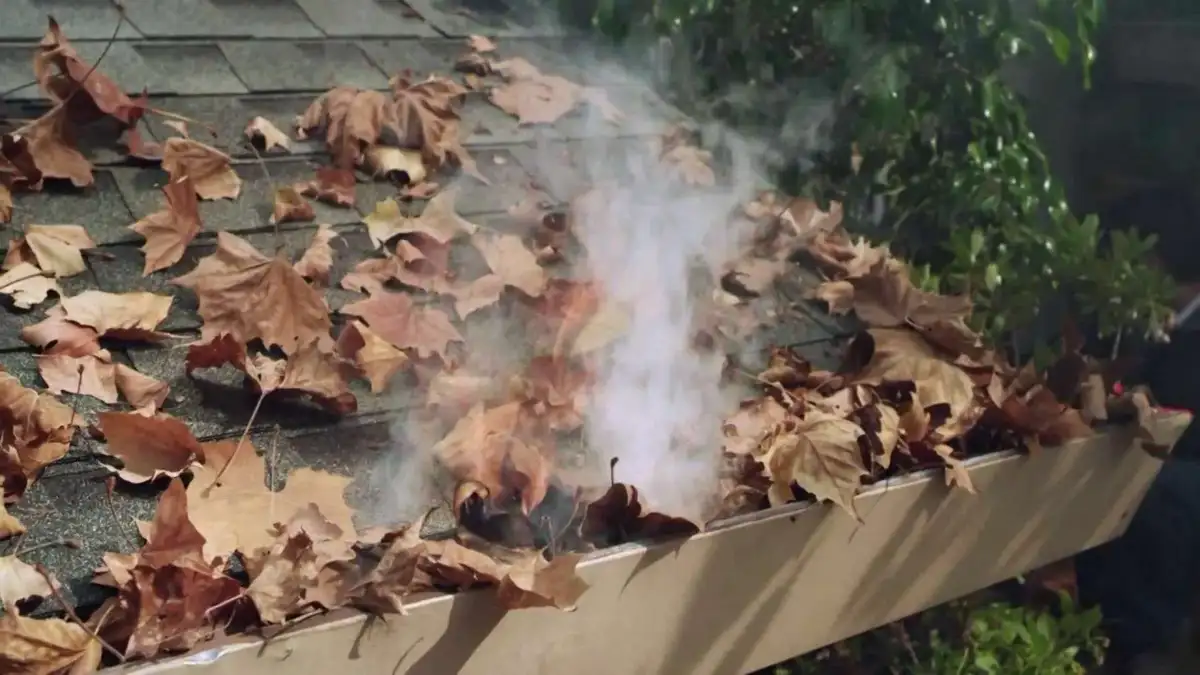
When an ember lands in debris-filled gutter material, it does not necessarily produce an immediate flame. It more commonly establishes a smouldering ignition that can persist for minutes without producing visible fire. This smouldering behaviour is in many ways more dangerous than immediate ignition because it is less visible, harder to detect from a distance and has more time to transfer heat to adjacent materials before it is noticed.
A smouldering ember in dry gum leaf debris in a North Shore gutter generates heat that rises into contact with the fascia board above and the roof edge at the eaves. Timber fascia boards, particularly older painted timber that has dried through the preceding fire weather conditions, can ignite from sustained contact with this heat source. Once the fascia is alight, the fire has access to the roof space through the eaves gap, and a structural fire is established that may not be visible from street level until it is well developed.
The NSW Rural Fire Service’s Building in a Bushfire Environment guidelines specifically identify debris-filled gutters as a high-risk feature in ember attack scenarios. The RFS’s community fire safety resources consistently list clean gutters as a fundamental preparation step for bushfire season, placed alongside other ember protection measures like screening under-floor areas and maintaining clearance around the building perimeter.
This guidance is not precautionary in the general sense. It reflects documented evidence from post-fire building assessments conducted after major fire events in NSW and other states, where the ignition sequence described above was identified as the cause of structural loss in a significant proportion of assessed properties.
Not all leaf debris in gutters presents the same fire risk. The specific debris types that accumulate in North Shore gutters from the area’s dominant native vegetation are among the most combustible available.
Eucalyptus leaves. Dry gum leaves contain volatile oils that lower their ignition temperature and increase heat output during combustion. A handful of dry gum leaves in a gutter is qualitatively more dangerous from a fire perspective than the same volume of dry plane tree or liquidambar leaves from a less fire-prone species.
Bark strips. Angophora and smooth-barked eucalyptus bark sheds in strips that retain their three-dimensional shape in a gutter rather than compacting flat. This structure creates air pockets within the debris that promote combustion, allowing oxygen to circulate within the fuel bed as it burns. A debris layer that includes bark strips burns more intensely and sustains combustion more effectively than flat-compacted leaf debris alone.
Dry organic dust and fine debris. The fine organic material that settles at the base of gutter debris in North Shore properties creates a tinder-like substrate that ignites readily from a small ember and sustains the combustion that allows larger debris to catch. This fine material is the component that connects an ember landing in the gutter to a sustained ignition event.
A gutter that has been cleaned recently and has accumulated only a thin layer of debris presents a meaningfully lower fire risk than one that has been accumulating material for twelve months or more. The relationship between debris depth and fire risk is not perfectly linear, but the principle is clear: more fuel means more risk.
On the North Shore, where native vegetation sheds year-round, a gutter that is cleaned once in September and then not touched again will carry an increasingly significant fuel load through November, December and January, which is precisely the period when fire weather conditions are most likely. The timing of maintenance relative to fire season is as important as the frequency.
For North Shore homeowners in bushfire-prone areas, gutter maintenance needs to be approached as a fire safety measure alongside its standard drainage function. This reframing changes the timing priorities and the thoroughness standard that is appropriate.
The fire season on the North Shore and greater Sydney region typically runs from October through to March, with the highest risk periods falling in late spring and summer when vegetation is driest and north-westerly fire weather is most prevalent.
The NSW RFS fire preparation guidance recommends completing property preparation, including clearing gutters, before fire season begins. For North Shore homeowners, this means the September clean is the most fire-safety-critical service of the year.
A practical fire-season maintenance schedule for a North Shore property in a bushfire-prone zone:
Gutters are the most discussed component of debris-related fire risk on residential rooftops, but they are not the only one. Roof valleys, the internal angles where two roof planes meet, collect debris in the same way gutters do and present equivalent ignition risks when filled with dry native leaf material.
On North Shore properties with complex roof designs, which are common in the area’s larger homes and Federation-era properties, multiple roof valleys may be present and may accumulate significant debris between professional services. A thorough pre-fire-season clean should address roof valleys and any flat or low-pitch roof sections alongside the gutters rather than treating the gutters as the only risk point.
The broader Australian evidence on residential fire risk from leaf debris in gutters is worth understanding because it provides the context for why fire authorities across the country treat this as a serious preparedness issue rather than a general maintenance reminder.
Post-fire building assessments conducted after major Australian fire events, including the Black Summer fires of 2019 to 2020 and numerous earlier events in NSW and Victoria, have produced consistent findings about the role of gutter debris in residential ignitions.
The Bushfire and Natural Hazards CRC research on building performance in bushfires has identified ember attack through debris-filled gutters as a documented ignition pathway in a significant proportion of residential losses, particularly in cases where the home’s construction materials and design would otherwise have provided reasonable protection against direct flame contact. In these cases, debris in gutters was the vulnerability that allowed ember attack to establish a structural fire despite the building’s other protective features.
This finding is significant because it means that gutter debris can undermine the value of other fire preparation measures. A home with screened eaves, appropriate construction materials and defensible space around the perimeter can still be lost to a fire that started in debris-filled gutters. The gutter preparation step is not secondary to other measures. It is in parallel with them.
The Insurance Council of Australia notes that home insurance policies typically contain conditions around reasonable maintenance of the property. In the context of bushfire damage claims, an assessor who determines that gutters had not been maintained and that gutter debris contributed to the ignition pathway may assess the claim differently to one where maintenance was demonstrably current.
Keeping dated records of professional gutter cleaning services, particularly pre-season cleans, is therefore relevant not just to fire risk management but to the insurance position of the property in the event of a claim.
For North Shore homeowners considering gutter guards as part of their fire preparation approach, the specification of the guard matters significantly. The NSW RFS ember guard specification calls for metal mesh with a maximum aperture of 2mm to prevent ember entry through gutters. Only mesh that meets this specification provides genuine ember protection alongside the debris management benefit.
Aluminium mesh guards at the correct aperture are the appropriate product for bushfire-prone North Shore properties. Foam inserts, brush guards and plastic mesh products do not meet the ember protection standard and in some cases present additional fire risks because they retain embers or combustible material rather than excluding them.
GutterGorilla’s North Sydney service page provides information on professional gutter cleaning and fire-season maintenance services available across the North Shore and northern suburbs.
NSW Rural Fire Service, Home Bushfire Preparation and Ember Attack Guidance: https://www.rfs.nsw.gov.au/
Bushfire and Natural Hazards CRC, Research on Ember Attack and Residential Ignition Pathways: https://www.bnhcrc.com.au/
Australian Standard AS 3959, Construction of Buildings in Bushfire-Prone Areas: https://www.standards.org.au/
Bureau of Meteorology, Fire Weather and Greater Sydney Climate Data: http://www.bom.gov.au/
Insurance Council of Australia, Home Insurance and Building Maintenance: https://www.insurancecouncil.com.au/
Leaf-filled gutters on North Shore homes do make those properties more vulnerable to bushfire. The mechanism is documented, the risk is identifiable and the solution is entirely within the homeowner’s control.
Keeping gutters clear, particularly in the weeks before fire season begins and through the highest-risk months of the year, removes the primary fuel source for the ember-to-structural-ignition pathway that post-fire research has consistently identified as a leading cause of residential losses. It does not guarantee a home will survive a major fire event. No single measure can. But it removes a vulnerability that is straightforward to address and that fire authorities consistently identify as one of the most important preparation steps a homeowner can take.
For properties on the North Shore, where the combination of native tree canopy, proximity to bushland and classic Australian fire weather creates a genuine and recurring risk, this maintenance step carries more significance than its routine appearance suggests.