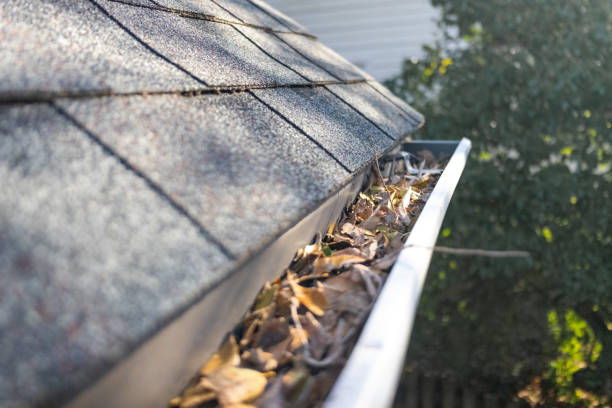

Anyone who has lived in the Inner West long enough knows the seasonal rhythm. The jacarandas drop purple blossom across everything in spring. The plane trees shed bark and leaves for what feels like months. Fig leaves land in gutters and compact into a dense mat that blocks water flow before most homeowners have even noticed it happening.
Gutter guards get brought up as a solution fairly often in this context, and the question of whether they actually work in an Inner West environment is worth answering properly rather than with a simple yes or no. The honest answer is that it depends almost entirely on which type of guard is installed, and most of the options on the market are not well suited to what Inner West gutters actually face.
To understand whether gutter guards can help in the Inner West, it helps to first understand the specific nature of the leaf and debris problem in this part of Sydney.
The Inner West is not a native bushland suburb. Its tree coverage is dominated by large introduced species planted along streets and in residential gardens over many decades, along with some native species in parks and newer plantings. That distinction matters because the debris these trees produce behaves differently to the fine, continuous shedding of eucalypts and banksias found in northern suburbs.
Plane trees, which line streets throughout Newtown, Leichhardt, Balmain and Annandale, produce large leaves, long strips of peeling bark and small round seed balls that break apart into fibrous material. These seed balls are a particular problem because they disintegrate into fine stringy debris that passes through or catches on many types of gutter guard rather than shedding cleanly off the surface.
Jacarandas contribute both leaves and dense blossom falls in spring, and the blossom material is sticky and fine enough to pass through any guard with an aperture large enough to let water through. Fig trees drop smaller, tougher leaves that accumulate efficiently and decompose slowly.
Liquidambars, common in older Inner West gardens, produce distinctive star-shaped leaves and spiky seed balls that are large enough to sit on top of some guards but small enough to partially enter others.
The combined result is a debris mix that varies in size, texture and behaviour across the seasons, which is precisely why a single guard solution that works well for all of it is difficult to find.
The realistic expectation for a gutter guard in an Inner West environment is not zero maintenance forever. That expectation is what leads to disappointment and to guards being removed after a few years of not delivering what was hoped for.
A well-chosen and properly installed gutter guard in the Inner West should reduce the frequency of full professional cleans needed, reduce the volume of debris that enters the gutter and downpipe, and prevent the kind of sudden complete blockage that causes overflow during heavy rain. It should not be expected to eliminate the need for periodic inspection and maintenance entirely.
The guards that come closest to meeting that realistic expectation in Inner West conditions are aluminium mesh guards with an appropriate aperture size. The guards that consistently fall short are foam inserts, brush guards and lightweight plastic mesh products, for reasons that the Inner West debris profile makes clear.
Walking through the main guard types available in the Australian market and how each performs against the Inner West’s specific conditions gives a clearer picture of what is actually worth considering.
Foam gutter inserts fill the interior of the gutter with a porous foam material that is supposed to allow water through while blocking debris. In theory this sounds reasonable. In practice, foam performs poorly in almost every real-world environment but particularly in the Inner West.
The fine fibrous debris from plane tree seed balls and jacaranda blossom does not sit on top of foam and blow away. It works into the cellular structure of the foam and accumulates there over time. Roots from nearby trees and plants find the consistently moist foam an attractive growing medium and begin to colonise it. The foam itself degrades under UV exposure and Sydney’s summer heat, breaking down into smaller pieces that can end up in the gutter and downpipe.
After two to three years in an Inner West environment, foam inserts typically need to be removed and replaced entirely, having accumulated a layer of organic matter through their full depth that makes them harder to deal with than an unguarded gutter would have been.
Brush guards use a cylindrical bristle insert that sits in the gutter, allowing water to filter through the bristles while larger debris is supposed to sit on top. The problem in the Inner West is that the debris mix does not cooperate with this premise.
Fine material from jacaranda blossom and plane tree seeds works into the bristles and stays there. Over a season or two the bristles become matted with organic matter, the effective filtration is lost and what you have is a gutter filled with a debris-laden brush that is considerably harder to clean than an open gutter. The bristles themselves also degrade over time and shed material into the downpipe.
Brush guards are not recommended for Inner West conditions.
Lightweight plastic mesh products sit at the lower end of the market in terms of both price and durability. They are typically clip-on systems that attach to the gutter without screws or brackets.
The aperture on many of these products is large enough to let smaller Inner West debris types through while still catching enough material on the surface to become blocked. The plastic warps in high heat and becomes brittle under extended UV exposure, which is a significant issue in a Sydney environment where summers are intense. Most products in this category have a functional lifespan of three to five years before warping or brittleness causes them to fail or detach.
Lightweight plastic mesh is not worth investing in for Inner West properties.
Aluminium mesh guards are a different product category entirely and the only type genuinely worth considering for Inner West gutters. Here is why they hold up where other options do not.
The material is inherently UV stable and does not degrade under sun exposure the way plastic does. It handles Sydney’s thermal cycling, the expansion and contraction from hot summers and cooler winters, without warping or becoming brittle. A properly installed aluminium mesh guard fitted by a professional can last twenty years or more on a well-maintained property.
The aperture size of aluminium mesh guards is critical to their effectiveness in the Inner West specifically. A mesh with an aperture in the 2mm to 4mm range allows water to pass through freely while excluding the majority of the debris types found in this environment. Fine material like jacaranda blossom and plane tree seed debris does accumulate on the mesh surface over time, but it tends to dry out and blow clear more readily than it would if it had entered the gutter directly.
The aluminium frame and fastening system means the guard sits securely and maintains consistent contact with the gutter edge, preventing gaps where debris can bypass the guard and enter the gutter at its edges.
The conversation about gutter guards in the Inner West comes back to the same conclusion from multiple directions: aluminium mesh is the only product type that is genuinely fit for purpose in this environment.
Not all aluminium mesh products are equivalent. These are the specifications that matter for Inner West conditions.
Aperture size. For the Inner West debris mix, a finer mesh in the 2mm to 3mm range performs better than a coarser product. Coarser mesh allows more of the smaller debris types through and provides less filtering benefit.
Frame and fixing system. The mesh should be mounted in a rigid aluminium frame that is fixed to the gutter with appropriate screws or clips rather than simply resting in position. A guard that can be displaced by wind or debris accumulation is not providing reliable protection.
Corrosion treatment. The aluminium should be anodised or powder-coated to resist the corrosion that comes from prolonged contact with wet organic debris. Untreated aluminium weathers over time in these conditions.
Profile compatibility. The guard needs to match the profile of the existing gutter. A guard designed for a quad gutter will not install correctly on a half-round or box gutter profile. Installation on the wrong profile creates gaps that undermine the whole purpose.
The best aluminium mesh guard installed poorly performs significantly worse than the same product installed correctly. Common installation issues that reduce effectiveness include:
Professional installation by someone experienced with the specific product and gutter profile is genuinely important. It is not a product that benefits from a DIY approach unless the homeowner has directly relevant experience.
Even the best aluminium mesh guard in the Inner West does not eliminate maintenance. It changes the nature of maintenance rather than removing it entirely.
Fine debris, particularly from jacaranda blossom and decomposed organic material, will accumulate on the mesh surface and eventually reduce water infiltration if left indefinitely. The guards need to be inspected annually and cleaned off periodically. Downpipes also still need to be flushed to confirm they are clear, as fine material that passes through the mesh over time can accumulate at downpipe inlets.
The practical benefit is that a properly installed aluminium mesh guard typically reduces the required clean frequency from two to three times per year to once per year for many Inner West properties, while significantly reducing the risk of sudden complete blockage during heavy rain events.
For homeowners in the Inner West weighing up whether a gutter guard installation makes financial sense, understanding the cost involved and what it buys over time is the right starting point.
Professional aluminium mesh gutter guard installation costs in the Inner West vary based on the linear metres of guttering to be covered, the roof height and access complexity, and the specific product specified.
As a general guide for Inner West residential properties:
These figures reflect professional installation of a quality aluminium mesh product. Cheaper quotes often reflect a lesser product, inadequate fixing or installation that skips the preparation steps that determine long-term performance.
Beyond the direct cost recovery, the reduction in overflow risk and the associated protection of fascia boards, wall cladding and internal finishes represents a less quantifiable but meaningful additional benefit for Inner West properties where timber and rendered surfaces are common.
Gutter guards work best when they are part of a maintained system rather than a replacement for maintenance. Installing guards over gutters that have existing structural issues, incorrect pitch or deteriorated downpipes simply protects a system that is already not functioning correctly.
The right sequence is to have gutters professionally cleaned and inspected, address any structural issues identified, and then install guards as a protective measure on a system that is confirmed to be in good working order.
For Inner West homeowners researching gutter guard options and what is available locally, GutterGorilla’s gutter guard page covers the products and installation approach in detail.
Homeowners in the Inner West wanting to understand the full picture of local gutter maintenance, including cleaning, inspection and guard options relevant to the area’s specific housing stock and debris profile, can find that information on GutterGorilla’s Inner West service page.
The Inner West is a challenging environment for gutter guards because of the variety and behaviour of its debris mix. Most products on the market are not designed to handle it well, and installing the wrong type of guard creates a different set of problems rather than solving the original one.
Aluminium mesh guards, properly specified and professionally installed, are the exception. They perform reliably in Inner West conditions, last for many years without significant degradation and genuinely reduce the maintenance burden on a gutter system rather than just transferring it.
The question is not really whether gutter guards help in the Inner West. The question is which one, installed by whom, and as part of what broader maintenance approach. Get those details right and the answer to the original question is yes, they do help.