Gutters are one of those parts of the house that only get attention when something goes wrong. They sit up on the roofline, doing their job quietly until they stop doing it, and by the time most homeowners notice a problem the bill that follows is rarely a small one.
The relationship between neglected gutters and expensive home repairs is not theoretical. It plays out across thousands of Australian properties every year, and the pattern is consistent: a maintenance cost that would have been modest becomes a repair cost that is significant, simply because the early warning signs were missed or ignored. Understanding what those signs are, what the damage costs when it develops, and what it takes to stay ahead of the problem is the most useful financial knowledge a homeowner can have about the part of their home they look at the least.
The idea that gutters could be responsible for thousands of dollars in home damage is not something most homeowners intuitively accept. The gutter is a simple piece of metal. How much damage can it really cause?
The answer comes from understanding what gutters protect rather than what they are made of. A gutter system in good working order intercepts every litre of rain that falls on the roof and directs it away from the building through a controlled pathway. When that system fails, every litre that was supposed to go through the downpipe and away from the house goes somewhere else instead. Over months and years of rainfall, that somewhere else is the building fabric itself.
The damage types that result from gutter failure are well-documented and carry well-established repair costs in the Australian building trade. These are not edge cases or worst-case scenarios. They are the predictable outcomes of deferred gutter maintenance at various stages of progression.
Fascia and rafter end damage. The fascia board runs along the roofline directly behind the gutter and is the first structural element to be affected by gutter overflow or standing water in a blocked gutter. On older properties across Sydney and major Australian cities, these are timber elements that absorb moisture when their protective paint layer fails. Rot in fascia boards progresses to the rafter ends that extend through or to the fascia, and rafter end damage involves structural roof timber rather than simply cosmetic elements.
Fascia replacement on a standard residential property in Sydney costs between $1,500 and $5,000 depending on the extent of the damage and access requirements. If rafter ends are involved, the cost increases because structural carpentry is needed in addition to the fascia work. A full fascia and rafter end restoration on a larger two-storey property can reach $8,000 to $12,000.
Ceiling water damage. Water that enters through the roof edge from backed-up overflow or through the fascia from persistent standing water eventually finds its way through insulation, ceiling battens and the ceiling lining below. Plasterboard ceiling repair for a water-damaged section costs $500 to $3,000 depending on the area affected. Lath-and-plaster ceilings in older homes are more expensive to repair, requiring specialist trades and costing $2,000 to $8,000 for damaged sections. In both cases, the repair cost is compounded if the ceiling has been wet through multiple rain events and mould has established in the cavity above.
External wall and render damage. Overflow that runs down external walls repeatedly causes paint adhesion failure, render cracking, efflorescence on brick and eventual moisture penetration through the wall structure. Render repair and repainting on a single external wall of a Sydney home typically costs $1,000 to $4,000. Where moisture has penetrated through to the internal wall lining and caused plaster damage or mould, the internal repair adds to that figure.
Subfloor and foundation effects. Overflow water that consistently deposits at the base of the building saturates soil adjacent to the foundation. On older homes with unreinforced brick footings or rubble foundations, this saturation causes movement over time. On homes with suspended timber floors over a subfloor cavity, it raises subfloor humidity to levels that promote timber decay in bearers, joists and flooring. Subfloor timber repairs start at $2,000 for minor damage and escalate to $10,000 or more for widespread joist and bearer replacement.
Mould remediation. Persistent moisture contact from gutter overflow creates ideal conditions for mould growth in wall cavities, ceiling spaces and subfloor areas. Minor mould remediation on accessible surfaces costs $500 to $1,500. Where mould has established in enclosed cavities requiring wall or ceiling removal to access, remediation costs can reach $3,000 to $8,000 or more depending on the extent.
Adding these damage types together for a property that has experienced multiple wet seasons without adequate gutter maintenance produces a total repair bill that regularly reaches $10,000 to $30,000 or more. Against these figures, the cost of a professional gutter clean, typically $150 to $450 per service depending on property size and location, looks like exactly what it is: one of the best-value maintenance investments available to a homeowner.
The financial damage from gutter neglect does not arrive in a single event. It accumulates progressively, with each wet season adding to what the previous ones started. This compounding nature is part of why the eventual bill surprises homeowners who feel they only missed maintenance for a year or two.
Moisture that enters timber begins a rotting process that accelerates once it is established. Rot that has progressed for two years is not twice as bad as rot that has progressed for one year. It is typically worse than that because the structural integrity lost in the first year makes the element more vulnerable to the second year’s moisture input. The damage curve bends upward rather than being linear, which means early intervention has a disproportionately positive effect on the eventual outcome.
The Australian Building Codes Board notes in its guidance on building performance and maintenance that moisture management in residential buildings is most cost-effectively addressed at the prevention stage, and that deferred maintenance of drainage systems is a primary driver of progressive structural deterioration in Australian residential stock.
The challenge with gutter-related damage is that the most consequential problems develop in spaces that are not routinely visible. Moisture in a wall cavity, rot in a rafter end and standing water in a downpipe are not things that announce themselves clearly until the damage is already well-established.
Knowing the external and internal indicators that suggest something is wrong with the gutter system, and taking them seriously when they appear, is the most practical way to catch damage at a stage where it is still affordable to address.
Rust staining on external walls. Brown or orange staining running down from the gutterline on rendered or masonry walls indicates that the gutter above is corroding and that rust-laden water is overflowing or leaking. The staining itself is repairable, but it is a symptom of an ongoing moisture issue that will cause more significant damage if the gutter is not addressed.
Paint peeling on fascia boards. Paint adhesion failure on the visible face of a fascia board indicates moisture is working from behind it. The back face of the fascia, which sits against or behind the gutter, may be significantly more deteriorated than the visible front face suggests.
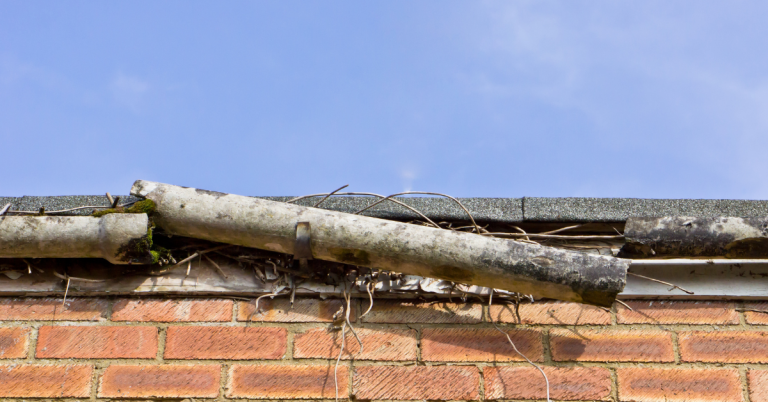
Visible sagging in the gutter run. A gutter that dips or curves when viewed from ground level has lost bracket support. This indicates either bracket corrosion, fascia deterioration at the fixing points or debris weight causing structural displacement. A sagging gutter pools water rather than draining it, accelerating further damage at the low point.
Overflow staining below the gutter line. Brown or green staining on external walls running downward from the gutter edge indicates overflow is occurring during rain events. The staining may be intermittent initially, appearing after heavy rain, and becoming more persistent as blockages worsen.
Vegetation growing from gutters. Weeds, grass or small plants growing from a gutter indicate a debris layer that is deep enough, old enough and continuously moist enough to support plant life. This level of accumulation typically represents multiple seasons of inadequate maintenance and a blockage that has been causing overflow and moisture contact with adjacent building elements for the same period.
Separation or gaps at gutter joints. Joints between gutter sections that have separated allow water to escape at the wall rather than draining to the downpipe. This type of failure delivers moisture directly to the fascia and wall behind the joint on every rain event and is often not visible without specifically looking for it.
Ceiling stains near the roofline. Any discolouration, staining or soft area in a ceiling near the eaves or in rooms directly below the gutterline that correlates with wet weather is a signal that moisture is entering from the roof perimeter. By the time a stain is visible, the material above the ceiling surface has typically been wet through multiple rain events.
Damp smell after wet weather. A musty or damp smell in rooms near external walls, particularly in the roof space if accessible, after heavy rain indicates moisture presence in enclosed spaces. This smell often precedes visible mould growth and should be investigated rather than dismissed as a temporary consequence of rain.
Mould at wall and ceiling junctions. Mould growth where internal walls meet ceilings near the roofline is a late-stage indicator that moisture has been present in the wall or ceiling cavity for an extended period. Mould at this location almost always has a moisture source at the roof perimeter rather than from condensation.
Preventing gutter-related repair costs is achievable for most Australian homeowners with a combination of regular professional maintenance and basic self-monitoring between services.
A systematic inspection approach that does not require getting on the roof covers the most important indicators and can be completed in under thirty minutes on most properties.
Ground-level exterior inspection. Walk the full perimeter of the building and observe the gutterline from ground level. Look for:
During and immediately after rain. Rain events are the best diagnostic opportunity for gutter condition.
Interior ceiling check. Walk through the home after any significant rain event and check ceilings in rooms near the roofline for any new staining or damp areas that were not present previously.
When engaging a professional gutter cleaning service, confirming that the following elements are included ensures the service actually prevents the damage outcomes described above.
A service that skips downpipe flushing or provides no condition report is not a complete service regardless of the price. The downpipe is where the most consequential blockages form, and the condition report is what identifies the structural issues before they become expensive repairs.
For most Australian residential properties, two professional cleans per year provides the baseline maintenance that keeps gutter-related repair risks manageable. The exact frequency should be adjusted based on:
Properties with significant native tree coverage, coastal exposure or older gutter systems should treat three cleans per year as the appropriate starting point rather than waiting for visible problems to prompt an increase in frequency.
At some point in the life of a gutter system, the question shifts from maintenance to replacement. Understanding when repair is still the right response and when replacement is the more cost-effective decision is a practical financial question that most homeowners eventually face.
Repair is appropriate when the gutter system has isolated issues that can be addressed without compromising the integrity of the full system.
The limitation of repair is that it only makes sense when the underlying system has remaining service life. Repairing a bracket on a gutter that is otherwise corroded throughout is spending money on a system that will fail at multiple points within the next year or two regardless.
The signals that indicate replacement is more appropriate than continued repair include:
Gutter replacement costs for a standard single-storey Sydney home typically run from $1,500 to $4,000 for a standard residential profile in Colorbond, including removal of the old system and installation of new gutters and downpipes. For a two-storey property or one with more complex roof configurations, costs range from $3,000 to $8,000 or more.
On a property worth $1 million or more, which describes a significant proportion of Sydney residential properties, the cost of gutter replacement is a fraction of one percent of the asset value. The cost of the structural damage that a failed gutter system causes is a much larger fraction of that value and is also recorded on building inspection reports, affecting buyer confidence and sale outcomes.
The Insurance Council of Australia data on home insurance claims identifies water damage as consistently among the top claim categories in New South Wales, with a significant proportion of those claims having their origin in drainage system failures that were either unaddressed or addressed too late.
The Real Estate Institute of NSW notes that building condition is a primary factor in how buyers assess value and determine offers. A property with a clean inspection report, supported by documented maintenance history, consistently achieves better outcomes than a comparable property with visible maintenance deficiencies. Gutter condition and its consequences for fascia, ceiling and wall elements are among the most commonly identified findings in pre-purchase building inspections.
Maintaining and where necessary replacing the gutter system before it causes structural damage is therefore not just a maintenance decision. It is a decision about the condition and value of the property as an asset.
GutterGorilla’s gutter cleaning service provides information on professional gutter maintenance, what a thorough service should include and how to evaluate providers: https://guttergorilla.com.au/gutter-cleaning/
Australian Building Codes Board, Guidance on Moisture Management and Building Maintenance: https://www.abcb.gov.au/
Insurance Council of Australia, Home Building Insurance and Water Damage Claims: https://www.insurancecouncil.com.au/
Real Estate Institute of NSW, Property Presentation and Building Condition Guidance: https://www.reinsw.com.au/
NSW Fair Trading, Building Defects and Maintenance Responsibilities: https://www.fairtrading.nsw.gov.au/
Australian Standard AS/NZS 3500.3, Stormwater Drainage: https://www.standards.org.au/
Gutters rarely fail dramatically. They fail gradually, quietly and in the spaces where no one is looking, until the accumulated moisture contact, the structural deterioration and the mould development reach a threshold that produces a visible, urgent and expensive problem.
The thousands of dollars that neglected gutters cost Australian homeowners are not the result of bad luck or unpredictable weather. They are the predictable outcome of a maintenance gap that could have been closed for a few hundred dollars per year and was not.
The gutter system is not glamorous. It does not appear in listing photos or get discussed at renovation planning sessions. But it protects everything that does, and the cost of understanding that too late is consistently higher than the cost of understanding it early.