Solar panels are one of those investments that people tend to set up and then largely forget about. The system runs quietly in the background, the inverter app shows numbers that look roughly right, and life moves on. What does not move on is the layer of grime building up on the panel surface month after month.
For homeowners in Sydney’s Inner West, this is a more significant issue than it might appear. The suburb sits in an urban environment with specific contamination sources that work against solar panel performance in ways that are easy to underestimate until you actually look at what is landing on your roof every day.
The Inner West is not a coastal suburb and it is not surrounded by dense native bushland. So you might reasonably assume solar panel soiling is less of a problem here than in, say, Hornsby or Manly. That assumption does not quite hold up.
The contamination environment in suburbs like Newtown, Marrickville, Leichhardt, Balmain and Annandale is shaped by a distinct combination of factors that does not apply to most other parts of Sydney.
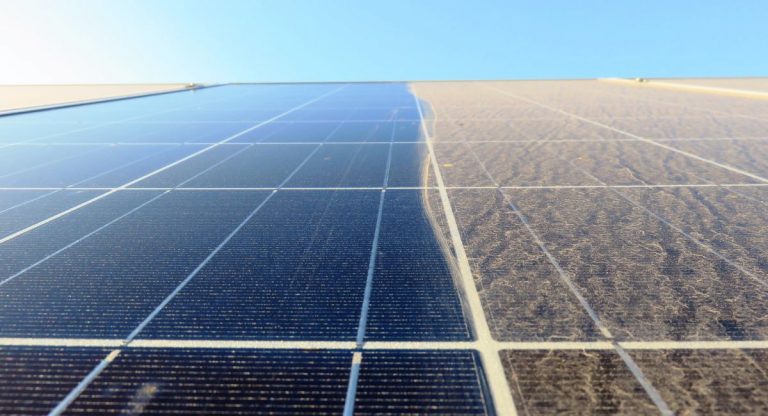
Traffic pollution. The Inner West has some of the highest traffic density in Sydney outside the CBD. King Street, Parramatta Road, Victoria Road and the surrounding arterial network generate significant quantities of fine particulate matter that settles across the suburb continuously. This fine carbon and rubber-derived dust is adhesive in nature and bonds to panel glass surfaces in a way that light rainfall cannot dislodge.
Industrial residue. Marrickville and parts of St Peters and Sydenham sit adjacent to long-established light industrial precincts. While these areas have evolved considerably over recent decades, residual airborne particulates from industrial activity in the broader corridor still contribute to surface contamination on nearby rooftops.
Urban tree canopy. The Inner West has invested heavily in street tree programs over many years. Plane trees, jacarandas, figs and liquidambars line streets throughout the area, each contributing pollen, organic dust and fine debris to the airborne environment. This is less intense than the native bush debris profile of northern suburbs but still meaningful in terms of what lands on panel surfaces over time.
Proximity to flight paths. Parts of the Inner West sit under approach paths for aircraft heading into Sydney Airport. Fine particulate matter from aviation activity adds to the overall atmospheric pollution load in the area.
Taken individually, none of these factors is dramatic. Taken together, they create an environment where solar panels accumulate a contamination layer faster than many homeowners in the area realise.
The physics of solar panel soiling is straightforward. Photovoltaic cells convert sunlight into electricity. Anything that sits between the sun and the cell reduces the amount of light available for that conversion.
A thin film of dust and organic residue that is barely perceptible to the naked eye can still reduce light transmission through the panel glass by a meaningful percentage. Concentrated deposits like bird droppings or compacted pollen reduce transmission significantly more in the areas they cover, and because of the way solar panel circuitry works, the effect on output extends beyond the physical footprint of the deposit itself.
What makes this particularly relevant for Inner West homeowners is that the contamination builds gradually and the output loss accumulates in small increments over time. There is no single moment where the problem becomes obvious. The system just quietly produces less than it should, day after day, until someone actually looks at the numbers properly.
The output loss from panel soiling varies considerably depending on how long panels have gone without cleaning, what specific contaminants are present, the angle of the panels and local weather patterns. Research into Australian urban solar installations provides a useful reference point.
Studies examining soiling losses on solar panels in Sydney urban environments show output reductions in the range of 5 to 20 percent for panels that have not been professionally cleaned over a twelve-month period. Some studies in high-pollution urban corridors show losses at the higher end of that range or beyond, particularly where traffic pollution and organic debris combine.
For an Inner West property, a reasonable working estimate for a system that has gone twelve months without cleaning is somewhere between 8 and 15 percent output reduction. This is not a worst-case figure. It is a realistic mid-range estimate for a suburb with the contamination profile described above.
A 6.6kW solar system producing an average of 25 kilowatt-hours per day under clean conditions loses roughly 2 to 3.75 kilowatt-hours daily at a 8 to 15 percent soiling reduction. At current NSW electricity prices and feed-in tariff rates, that daily loss represents between $0.70 and $1.40 depending on how that generation is used.
Across a full year, the financial loss from soiling on a single 6.6kW system sits somewhere between $250 and $500 for the range described above. Larger systems scale proportionally. A 10kW system experiencing 12 percent soiling loss over a year is losing closer to $600 to $700 in generation value.
The professional clean required to recover that output typically costs between $180 and $320 for a standard Inner West property. The arithmetic is not complicated.
Beyond the general surface soiling calculation, Inner West properties face a specific issue related to bird activity. The suburb’s mature tree canopy supports a healthy population of native and introduced birds, and roof-mounted solar panels are frequently used as perches.
Bird droppings cause a type of output loss that is disproportionate to their size. Because modern panels wire individual cells into strings, shading or blocking one cell reduces the output of the entire string, not just the cell itself. A dropping the size of a fifty-cent piece sitting over a single cell can suppress the output of a string containing many more cells for as long as it remains on the panel.
In practical terms, a panel array with several bird dropping deposits across different strings can experience output losses that exceed what general soiling estimates predict. Inner West properties with panels visible from surrounding trees tend to accumulate these deposits faster than properties in more open positions.
Rather than waiting for a noticeable problem, these indicators are worth checking regularly.
For Inner West homeowners looking to act on their panel maintenance, understanding what a quality service involves and what it should cost helps in making an informed decision rather than defaulting to the cheapest available option.
Solar panel cleaning services in the Inner West range from basic rinse-and-go operations charging under $150 to comprehensive professional services that include inspection, appropriate water treatment and documentation. The difference in outcome between these two ends of the market is significant.
A basic rinse using mains tap water removes loose debris but leaves behind the mineral deposits from the water itself as it evaporates. It also does not address the adhesive traffic-pollution film that characterises Inner West panel contamination, because that layer requires more than water pressure to break down effectively. In some cases, a mains water rinse followed by rapid drying in Sydney’s sun leaves panels in a marginally worse condition than before.
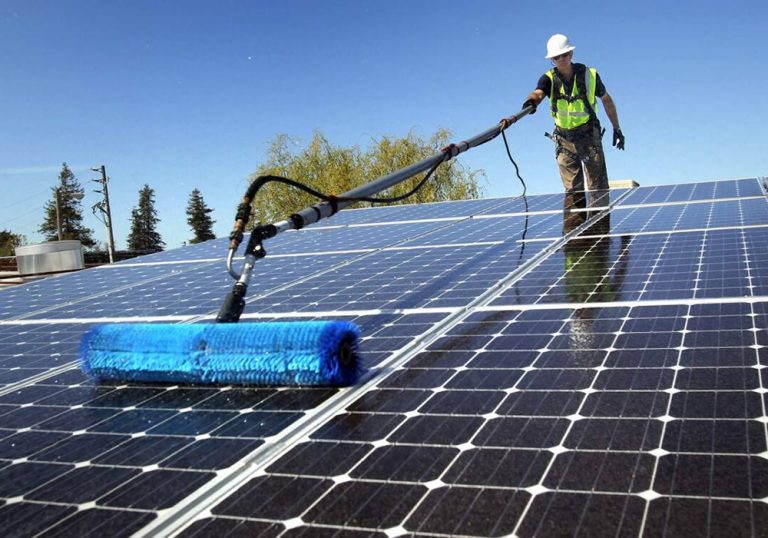
A thorough professional service using deionised or reverse osmosis water removes contamination properly because the water itself carries no dissolved minerals to leave behind. Combined with the right soft-brush technique for breaking down surface residue, this approach restores panel transparency to something close to its original specification.
Pricing varies by property and system size, but as a general guide:
Services at the lower end of this range and below it tend to reflect a more limited scope of work. Understanding what is included before booking is more useful than comparing headline prices directly.
The answers to these questions reveal more about the quality of a service than the price does.
The longer-term picture for Inner West solar panels is worth understanding, because the consequences of consistent soiling are not limited to the immediate output loss.
A panel surface that has not been properly cleaned does not simply accumulate a uniform layer of contamination. The process is more complex than that.
Initial contamination creates a slightly rough surface texture that captures subsequent particles more effectively than clean glass. Organic material begins to decompose on the panel surface, creating a mildly acidic microenvironment that can over time affect anti-reflective coatings if left unchecked. Traffic pollution residue binds with organic material to form a composite layer that becomes progressively harder to remove without professional equipment.
The practical consequence is that the rate of performance loss accelerates the longer panels go without a proper clean. A system that loses 8 percent output in the first year of neglect may lose a further 12 percent in the second year as the surface condition compounds. Getting back to full performance after extended neglect also requires more effort and potentially multiple cleaning sessions.
A professional cleaning visit provides something that cannot be replicated by monitoring data alone: a trained set of eyes at close range on the panels themselves.
Panel degradation issues including micro-cracking, delamination, hotspots and frame corrosion are often first identified during a cleaning service rather than through inverter monitoring, because the monitoring shows aggregate output without identifying where specific losses are originating. Catching these issues early typically means a warranty claim or minor repair rather than a panel replacement.
For Inner West properties where roof access involves navigating terrace layouts, narrow passages and challenging pitches, having a professional who is already safely on the roof take a close look at panel condition during a clean is a practical benefit beyond the cleaning itself.
One aspect of Inner West solar maintenance that is easy to overlook is the relationship between gutter condition and panel performance. Blocked or overflowing gutters on properties where panels are mounted near the roof edge create conditions where debris-laden water contacts panel frames and mounting hardware during overflow events.
Over time, repeated contact between organic debris and panel mounting components accelerates corrosion and can affect the structural integrity of the mounting system. Leaves and debris that accumulate in gutters directly below panel arrays also contribute to the overall organic material load on the roof, with fine decomposed particles becoming airborne and settling on panel surfaces.
Treating solar panel cleaning and gutter maintenance as connected rather than separate rooftop maintenance tasks makes practical sense for Inner West properties. GutterGorilla provides both services across the Inner West, and their Inner West service page covers what is available locally for homeowners managing both aspects of rooftop upkeep.
For homeowners specifically focused on solar panel cleaning and wanting to understand what a thorough professional service covers in terms of technique, equipment and what to expect from the process, GutterGorilla’s solar panel cleaning page provides detailed information on the service and what distinguishes a proper clean from a basic rinse.
The Inner West is a dense, active urban environment, and that environment takes a toll on solar panels in specific ways that are worth understanding rather than guessing at. Traffic pollution, bird activity, organic debris from street trees and proximity to industrial corridors all contribute to a contamination profile that meaningfully reduces output over time.
The good news is that the problem is entirely reversible with the right cleaning approach at the right frequency. For most Inner West properties, one to two professional cleans per year is sufficient to keep output losses within a narrow range and protect the long-term condition of the panels.
The cost of staying on top of it is modest relative to what is being recovered in generation output and what is being protected in terms of panel longevity and warranty compliance. For an investment that most Inner West homeowners paid between $6,000 and $12,000 to install, that maintenance commitment is a straightforward decision.