Most homeowners check their gutters after a blockage becomes obvious, usually after a storm when water is pouring over the edge in sheets. But gutters that are holding excess water do not always announce themselves that dramatically. Many of the most telling signs are subtle, appear in unexpected locations, and develop gradually over weeks or months before anything looks obviously wrong.
Understanding these less obvious signs gives homeowners the ability to catch drainage problems early, before standing water in gutters has had time to damage fascia boards, saturate external walls, or create the conditions for mould and structural timber deterioration.
A gutter that is holding excess water has, by definition, a problem that prevents water from draining away after rain events end. That problem might be a physical blockage, a loss of gutter pitch, a downpipe restriction, or a structural failure in the gutter run itself.
What makes these situations tricky is that standing water in a gutter is not visible from the ground and may not produce obvious overflow. The water simply sits there between rain events, slowly working on the surfaces it contacts, until secondary symptoms begin to appear elsewhere on the building.
Moving water through a drainage system is what gutters are designed for. Standing water is a different condition entirely. A gutter holding water between rainfall events exposes the gutter surface, the gutter-to-fascia junction, and the downpipe entry to prolonged moisture contact rather than the brief wetting that rain alone would produce.
In metal gutters, standing water accelerates corrosion at the base of the channel. In all gutter types, it creates conditions for mosquito breeding, algae and mould growth, and the build-up of organic sediment that progressively reduces the cross-sectional area available for drainage. The standing water is both a symptom of a problem and an accelerant of further damage.
It is worth distinguishing between a gutter that overflows during heavy rain and a gutter that retains water between events. Both indicate drainage system problems but they do not always have the same cause.
Overflow during rain typically points to a blockage, insufficient capacity, or a downpipe that cannot handle the flow rate required. Retained water between events often indicates a loss of gutter pitch, a blocked or partially blocked downpipe where water can eventually drain but too slowly, or a low point in the gutter run where water consistently accumulates. Identifying which problem you have determines which solution is appropriate.
The following signs are among the most reliable indicators that water is sitting in your gutters rather than draining correctly. Some are visible from the ground. Others require closer inspection or attention to patterns that emerge over time.
An increase in mosquito activity concentrated near the roofline or in the outdoor area directly below is one of the earliest and most commonly overlooked indicators of standing water in gutters. Mosquitoes can complete their development cycle in as little as one to two weeks in warm, still water.
If you notice mosquitoes appearing from the roofline direction during evenings in spring and summer, standing water in the gutter system is one of the first things worth investigating. This is particularly relevant in Queensland, New South Wales, and other subtropical regions where warm temperatures extend the mosquito breeding season.
For homes with steel gutters, rust staining at the base of the gutter channel or at the downpipe outlet is a visible indicator that water has been sitting in contact with the metal for extended periods. Normal rainfall moves through the system quickly enough that corrosion at the base is limited. Standing water accelerates that process significantly.
Orange-brown staining visible at the point where the downpipe meets the gutter is particularly informative because it indicates the downpipe entry is where water is consistently pooling, which points to either a partial downpipe blockage or a low point in the gutter pitch at that location.
Visible algae or dark biological growth on the gutter surface is a reliable sign that water is sitting in the channel long enough for these organisms to establish. Clean gutters that drain correctly do not accumulate sufficient persistent moisture for meaningful biological growth.
If you can see green streaking or dark deposits inside the gutter from a ladder position, or if biological staining is visible on the external face of the gutter below the waterline, standing water has been present for an extended period. In humid climates, this progression can occur within a single season of drainage failure.
A gutter that has been holding water for an extended period may show visible sagging between bracket points. The weight of water, combined with the weight of any debris in the channel, exceeds what the gutter profile was designed to carry continuously between bracket intervals.
Sagging creates a self-reinforcing problem. The low point that develops from sagging becomes the location where water consistently collects, which adds further weight and deepens the sag over time. A section of gutter that shows a visible bow between fixing points should be assumed to be retaining water even when it appears visually dry.
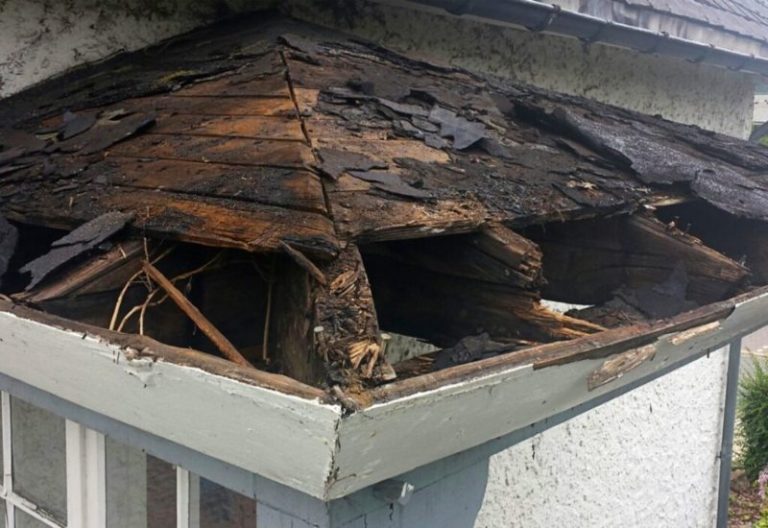
The fascia board directly behind a gutter that is holding excess water is in consistent contact with moisture. The gutter-to-fascia junction is rarely perfectly sealed, and water sitting at that level works its way into any gap between the gutter lip and the fascia face.
Fascia boards that feel soft when pressed, that show paint bubbling or cracking at the junction with the gutter, or that have discolouration suggesting long-term moisture contact are all signs that the gutter above has been holding water. By the time the fascia shows visible symptoms, the moisture contact has typically been occurring for a significant period.
A structured approach to inspecting gutters for water retention gives homeowners a reliable method for identifying problems that are not immediately obvious.
From the ground with good light conditions, look for:
Binoculars can be helpful for a ground-level inspection on two-storey homes or where the roofline is set back from the street.
The most informative time to assess gutter drainage is in the hour or two after light to moderate rain has ended. If the gutters are draining correctly, the downpipes should have stopped flowing within minutes of the rain stopping. Standing water in the gutter will not drain at this rate.
Observe whether downpipes continue to trickle or drip for an extended period after rain has ended. This suggests water is draining slowly from a low point in the gutter rather than having already cleared the system. Also check whether puddles or wet ground below the gutter line persist significantly longer than those in other areas of the garden, which may indicate slow or partial drainage at a specific location.
A blocked or partially restricted downpipe is the most common cause of water retention in gutters. During light rain, run a garden hose into the gutter at a volume roughly equivalent to the rainfall rate and observe whether the downpipe discharges the flow immediately and continuously or whether the water level in the gutter builds before draining begins.
If water builds in the gutter before the downpipe begins to flow, the downpipe has a restriction. The restriction may be at the entry point, at a bend lower in the pipe, or from sediment accumulation in the lower sections of the downpipe that is not visible from above.
Pressurised downpipe flushing is the most effective way to clear internal downpipe restrictions that cannot be resolved by surface cleaning or garden hose flushing alone.
Understanding the full range of problems that excess water in gutters causes, and the pathway to resolving each one, gives homeowners a complete picture rather than just a list of symptoms.
The long-term consequences of gutters holding excess water are more serious than the standing water itself suggests. The article on why stormwater overflow creates long-term property damage covers the structural and financial consequences in detail, including foundation saturation, timber decay, and the compounding cost of delayed maintenance.
In summary, unaddressed water retention in gutters contributes to:
For more articles on gutter maintenance, drainage systems, and related roof care topics, the Gutter Gorilla blog provides ongoing guidance for Australian homeowners across different property types and climate conditions.
Gutters that are holding excess water rarely present with dramatic symptoms at first. The signs are subtler, slower, and often appear in locations that are not immediately associated with the gutter system. Recognising them early, and understanding what they indicate about the drainage system behind them, gives homeowners the opportunity to address problems before they compound into the kind of structural and financial consequences that deferred maintenance eventually produces.