Anyone who has lived in Ku-ring-gai for more than a season knows that gutters here need more attention than almost anywhere else in Sydney. The question of whether a gutter guard can help, and which type actually works in this environment, is one that comes up regularly for homeowners across Gordon, Pymble, St Ives, Turramurra, Wahroonga and the surrounding areas.
The short answer is that one type of gutter guard performs reliably in Ku-ring-gai’s specific conditions. The longer answer involves understanding why every other option on the market falls short in this environment, and what genuine value a well-chosen guard system can deliver for a property that faces one of the most demanding native bushland debris profiles in the Sydney metropolitan area.
Evaluating gutter guards for Ku-ring-gai requires applying a different filter to the one used in most product comparisons. The standard question of whether a guard keeps leaves out is too simple for this environment. The more useful questions are whether the guard handles continuous year-round native debris, whether it holds up under Sydney’s UV intensity and Ku-ring-gai’s specific thermal conditions, and whether it is compatible with the bushfire risk that applies to a significant portion of the municipality.
Most gutter guard reviews and comparisons are written for a general Australian audience and based on conditions that do not reflect Ku-ring-gai’s native bushland environment. A product that performs adequately on a property in Penrith with a few deciduous street trees, or in a coastal suburb with light organic debris, may be entirely unsuitable for a Ku-ring-gai home beneath a mature eucalyptus canopy.
The debris profile in Ku-ring-gai includes large gum leaves that lie flat and layer efficiently, long bark strips from eucalypts and angophoras that can span the full width of a gutter, hard seed capsules from banksias and other native species that accumulate at downpipe inlets, fine organic dust and pollen that settles as a silt layer, and material from possum and bird activity that creates concentrated blockages rather than distributed accumulation.
No single gutter guard handles all of these debris types with equal effectiveness. The question is which type handles the combination most reliably over time, in this specific environment, without creating new problems that are harder to manage than an unguarded gutter would have been.
Before identifying what works, it is worth being direct about what does not, and why. This matters because the products that underperform in Ku-ring-gai are often the ones most prominently marketed at hardware stores and at the lower end of the price range.
Foam inserts. Foam fills the gutter interior with a porous block intended to allow water through while blocking debris. In Ku-ring-gai’s native environment, foam is one of the worst possible choices. Fine native debris, including eucalyptus seed capsules, banksia pollen, wattle dust and decomposed organic material, works directly into the foam’s cellular structure and accumulates there continuously. The foam retains moisture, which accelerates its own degradation and creates a permanently damp substrate that encourages root infiltration from adjacent vegetation.
There is also a bushfire consideration that makes foam entirely inappropriate for many Ku-ring-gai properties. The NSW Rural Fire Service ember attack guidelines specifically advise against foam gutter inserts in bushfire-prone areas, noting that they can retain burning or smouldering embers that arrive during ember attacks. Ku-ring-gai Chase National Park borders the municipality directly, and significant portions of the residential area are mapped as bushfire-prone land under NSW Planning’s bushfire prone land mapping. For these properties, foam gutter inserts present a genuine fire risk beyond their maintenance limitations.
Brush guards. Cylindrical bristle inserts share the fundamental problem of foam when it comes to fine native debris. The stringy bark fibres, wattle seed and fine organic dust typical of Ku-ring-gai’s environment works into the bristle structure and does not clear itself. Over one to two seasons the bristles become matted with embedded organic material, the guard’s filtering function is lost and what remains is a debris-filled insert that is harder and more expensive to deal with than an open gutter. Brush guards also present the same ember retention concern as foam in bushfire-prone areas.
Lightweight plastic mesh. Clip-on plastic mesh systems are sold at hardware stores across Sydney at price points that make them appear to be a sensible entry-level solution. In Ku-ring-gai, they are not worth the investment for several reasons that the local environment makes inevitable.
UV degradation is the primary issue. Australian Radiation Protection and Nuclear Safety Agency UV monitoring data shows the greater Sydney region regularly recording extreme UV index levels during summer, and Ku-ring-gai’s elevated, north-facing aspects in some areas intensify this exposure. Polymer-based gutter guard products that are not specifically formulated for sustained UV exposure become brittle and crack at fixing points within three to five years in these conditions. A system that needs replacement every four years delivers negligible value over a decade when the replacement cost and installation labour are factored in.
The coarser aperture typical of lightweight plastic mesh products is also less effective against the fine debris types common in Ku-ring-gai. Fine material passes through, accumulates as silt in the gutter below and is not addressed by the guard at all.
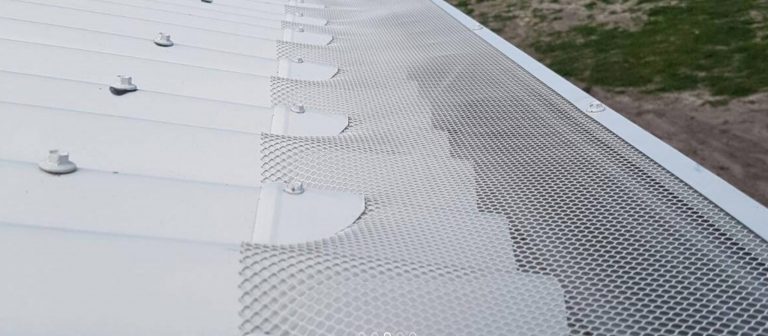
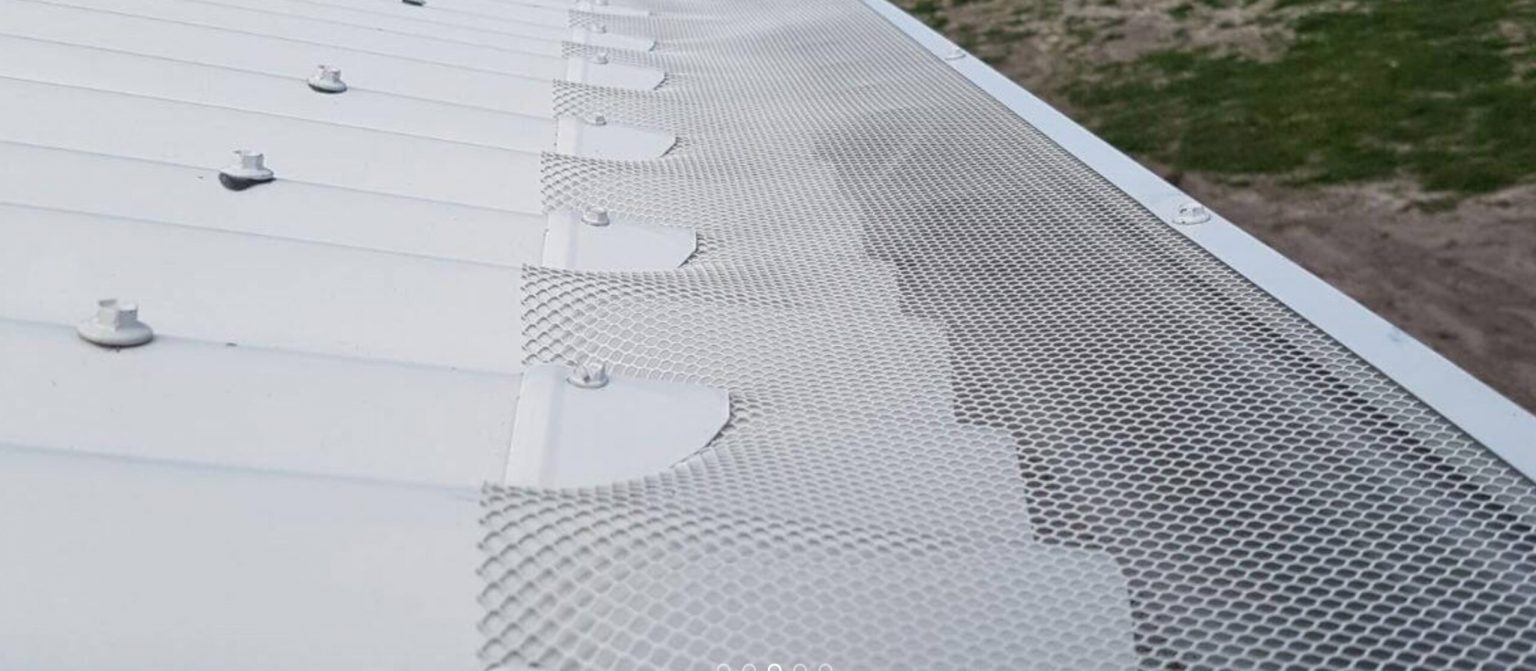
With foam, brush and lightweight plastic mesh eliminated as unsuitable for Ku-ring-gai’s conditions, the field narrows to aluminium mesh gutter guards. This is not a consolation shortlist. It is a product category that genuinely performs well in this environment for reasons directly connected to what Ku-ring-gai demands.
Aluminium mesh guards are fundamentally different from the alternatives in material durability, performance consistency and long-term cost effectiveness. The reasons they work in Ku-ring-gai are the same reasons they are used in demanding bushland environments across Australia.
UV stability. Aluminium does not degrade under ultraviolet exposure. A properly coated aluminium mesh guard in Ku-ring-gai’s sun-exposed environment looks and performs the same after fifteen years as it did after one year. There is no brittleness, no cracking at fixing points and no progressive loss of structural integrity from thermal cycling.
Bushfire compatibility. The NSW RFS ember guard specification calls for metal mesh with an aperture of 2mm or less to prevent ember entry through gutters during bushfire events. This specification aligns directly with the fine-grade aluminium mesh appropriate for Ku-ring-gai’s native debris profile. A property in a bushfire-prone part of Ku-ring-gai that installs a correctly specified aluminium mesh guard addresses both the maintenance need and the ember protection requirement simultaneously.
Handling native debris. The aluminium mesh frame holds its shape under the weight of wet native debris that would collapse or deform plastic products. Bark strips that land on aluminium mesh dry out and can be cleared during periodic maintenance. Leaf debris that accumulates on the mesh surface does not enter the gutter below at the same rate it would in an open gutter, which slows the accumulation significantly even in the most heavily treed Ku-ring-gai properties.
Longevity. A quality anodised or powder-coated aluminium mesh guard in Ku-ring-gai’s conditions has a realistic service life of fifteen to twenty-five years. Spread across that period, the installation cost represents one of the better maintenance investments available to a Ku-ring-gai homeowner.
Honesty about the limitations of aluminium mesh in Ku-ring-gai’s environment is important for setting realistic expectations.
Fine organic dust, fine pollen and the smallest debris particles from native vegetation will pass through any mesh aperture that permits adequate water infiltration. These particles settle as a silt layer at the base of the gutter below the mesh over time and require periodic flushing and cleaning. The accumulation rate is lower than in an open gutter, but it does not reduce to zero.
Aluminium mesh guards also do not address the possum and bird activity that contributes to Ku-ring-gai gutter blockages. Possum nesting material can accumulate on top of mesh rather than inside the gutter, which creates a different management challenge. Bird droppings that accumulate on mesh surfaces can restrict water infiltration if not periodically cleared.
The realistic expectation for a well-installed aluminium mesh guard on a Ku-ring-gai property is a reduction in clean frequency from three to four times per year to once or twice per year, with periodic mesh surface clearing and annual downpipe flushing. This is a genuine and meaningful reduction in maintenance burden. It is not a maintenance-free outcome.
For homeowners in Ku-ring-gai ready to invest in aluminium mesh gutter guards, the practical considerations of cost, product specifications and installation quality determine the long-term value delivered.
Several factors specific to Ku-ring-gai properties affect the cost of a professional aluminium mesh guard installation.
Linear metres of guttering. Larger Ku-ring-gai properties on generous blocks with complex roof designs have more guttering to cover. A straightforward rectangular roof on a modest single-storey home requires significantly less material and installation time than a large two-storey home with multiple roof planes, valleys and architectural features.
Roof height and access complexity. Two-storey homes and properties with steep pitches require more equipment and more time to access safely. Many Ku-ring-gai properties are built on sloped blocks, which affects ladder stability and access approach and is reflected in pricing.
Pre-installation work required. Guards should only be installed on clean, structurally sound gutters. If the gutters need significant cleaning, repair of brackets or fascia work before installation, these costs are additional to the guard installation itself. Providers who quote guard installation without addressing the underlying gutter condition are skipping steps that determine long-term performance.
Product specification. Within the aluminium mesh category, products vary in mesh aperture size, frame thickness, coating quality and fixing system. A bushfire-rated product with a finer aperture and a powder-coated frame costs more than a basic aluminium product but delivers meaningfully better performance in Ku-ring-gai’s specific conditions.
As a general guide for professionally installed aluminium mesh gutter guards on Ku-ring-gai residential properties:
These figures assume professional installation of a quality aluminium mesh product with appropriate pre-installation cleaning and structural assessment included. Significantly lower quotes typically reflect a product compromise, inadequate fixing or a scope that skips the preparation work that determines long-term effectiveness.
A Ku-ring-gai homeowner currently spending $350 per clean three times per year, totalling $1,050 annually, who installs aluminium mesh guards at a cost of $1,750 and subsequently reduces cleaning to once per year at $350 saves approximately $700 per year in cleaning costs.
Over ten years, that represents $7,000 in cleaning cost savings against a $1,750 installation investment, a net saving of $5,250 across the decade. Over the guard’s twenty-year lifespan the financial case strengthens further, with cumulative savings well exceeding $12,000 on the same calculation.
This does not include the value of reduced structural risk to the property from lower overflow frequency, which for a Ku-ring-gai home worth several million dollars represents a meaningful additional benefit that is harder to quantify but genuinely real.
Translating the product analysis into a practical decision framework for Ku-ring-gai homeowners involves a few specific considerations that narrow the choice further within the aluminium mesh category.
In most Sydney suburban environments, a 3mm to 4mm aperture aluminium mesh performs adequately. In Ku-ring-gai, the fine debris profile from native vegetation makes a finer specification worth considering.
A 1mm to 2mm aperture mesh excludes more of the fine organic material common in Ku-ring-gai’s native environment while still allowing adequate water infiltration during normal and moderately heavy rainfall. For the portions of Ku-ring-gai that are classified as bushfire-prone, a 2mm or finer aperture also meets the NSW RFS ember guard specification.
The trade-off with finer mesh is that it can restrict water entry during extreme rainfall events. For most residential roof pitches in Ku-ring-gai this is not a significant practical issue, but it is worth discussing with the installer when specifying the product.
In Ku-ring-gai’s storm-exposed environment, a guard that is merely resting in position or held by light clips is a guard that can be displaced by the wind and debris loading of a significant summer storm. Mechanically fixed systems that screw or clip securely to the gutter lip and the roof edge are more appropriate for this environment than press-fit or adhesive systems.
The frame should be thick enough to resist bending under the weight of wet debris accumulation. Lightweight frames that flex when loaded allow debris to push the mesh down into the gutter interior, reducing the guard’s effectiveness and potentially creating new blockage points.
The most common reason aluminium mesh guards underperform after installation is that they were installed on gutters that were not properly prepared. The correct sequence for a Ku-ring-gai installation is:
For Ku-ring-gai homeowners researching gutter guard options and wanting to understand what is appropriate for the municipality’s specific native bushland environment, GutterGorilla’s Ku-ring-gai page provides locally relevant information on products and services suited to the area.
Detailed information on gutter guard types, installation standards and what a professional installation service should include is available on GutterGorilla’s gutter guard page.
The gutter guard question in Ku-ring-gai does not have a range of reasonable answers depending on personal preference or budget. The environment is specific enough that the wrong product type creates problems rather than solving them, and the right product type, properly installed and appropriately maintained, delivers genuine and measurable value over a long service life.
Aluminium mesh, correctly specified for the fine native debris profile and bushfire risk applicable to much of the municipality, installed professionally on clean and structurally sound gutters, is the answer. Everything else is a compromise that the Ku-ring-gai environment will expose within a few seasons.