Solar panels are marketed with impressive output figures and twenty-five-year performance warranties. What is less consistently communicated is how significantly the environment in which a panel operates affects its actual real-world performance compared to the numbers on the specification sheet.
Those specification numbers are generated under Standard Test Conditions: a controlled laboratory environment with a specific irradiance level, a specific cell temperature, and no wind, humidity, dust, salt, or biological interference. The gap between those conditions and the conditions that panels actually face on Australian rooftops explains why many homeowners find their system consistently underperforms relative to what they expected when they made the investment.
This article examines the full range of environmental factors that affect solar panel performance, why their effects are larger than most homeowners anticipate, and what a realistic understanding of environmental impact means for maintenance decisions.
The energy transition in Australia has produced one of the highest rooftop solar adoption rates in the world. Millions of residential systems are now operating across every climate zone the continent offers, from the tropical north to the cool temperate south, from the arid inland to the humid coastal strip. This diversity of operating environments produces a wealth of real-world performance data that increasingly tells a different story from the idealised projections of the installation era.
Most residential solar systems in Australia were installed based on yield projections that used irradiance data for the specific location combined with the rated output of the chosen panels. These projections typically did not fully account for the cumulative performance reduction from environmental stressors that operate continuously on the system.
Research from solar monitoring platforms operating across Australian residential systems consistently shows that average real-world output is lower than modelled output by margins that vary by location but are rarely trivial. Environmental factors account for a meaningful proportion of this gap, and unlike irradiance variability, which is an inherent characteristic of solar energy, many environmental performance losses are partially or wholly recoverable through appropriate maintenance.
Australia’s geography and climate create an unusually demanding operating environment for solar panels compared to the European and North American conditions in which much of the original solar technology development and testing occurred. High UV intensity, extreme temperature ranges, coastal salt air affecting a large proportion of the population, and significant dust and bushfire smoke loads in many regions all combine to stress panel surfaces and system components at rates that European testing standards do not fully replicate.
Understanding the specific ways these factors reduce performance is the starting point for managing their effects.
The obvious weather factors that affect solar output, cloud cover, rain, and reduced daylight in winter – are well understood and factored into yield projections. The less obvious factors are where real-world performance diverges most significantly from expectation.
Most homeowners assume that more sun means more solar electricity. In terms of irradiance this is true, but there is a counteracting effect that partially offsets the benefit of sunny days: heat.
Solar panels generate less electricity as their cell temperature rises. This characteristic is described by the temperature coefficient of power, a figure that appears in every panel’s technical specification but that most buyers do not pay close attention to. A typical crystalline silicon panel loses approximately 0.35 to 0.45 percent of its rated output for every degree Celsius above 25 degrees, which is the Standard Test Condition reference temperature.
In Australian conditions, panel surface temperatures on a clear summer day can reach 60 to 75 degrees Celsius. At 70 degrees, a panel with a temperature coefficient of 0.40 percent per degree Celsius is operating at a temperature 45 degrees above its rated condition, producing a temperature-related output reduction of around 18 percent. This is not a maintenance issue and cannot be resolved by cleaning, but it explains why summer output is often lower than expected on hot days despite excellent irradiance conditions.
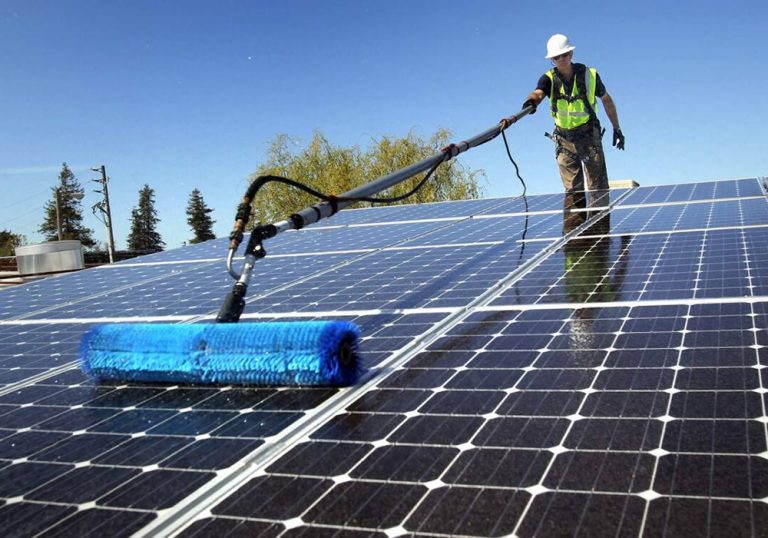
Airborne particulates that settle on panel glass reduce light transmission by scattering and absorbing incoming irradiance before it reaches the photovoltaic cells. The composition and behaviour of these particles varies significantly by location:
Research from Australian solar monitoring data shows that soiling losses in high-dust, high-salt, and smoke-affected environments routinely exceed five percent of annual generation, with higher losses during extended dry periods between rain events.
High atmospheric humidity affects solar panel performance through several mechanisms that are not well understood by most homeowners. Humidity increases the diffuse fraction of incoming solar radiation, meaning that a larger proportion of sunlight arrives from scattered sky rather than directly from the solar disc. Panels are typically more efficient at converting direct beam irradiance than diffuse irradiance, so high-humidity conditions reduce effective yield even when total irradiance is unchanged.
More significantly, sustained high humidity accelerates the degradation of several panel components. The encapsulant material that protects photovoltaic cells within the panel laminate is susceptible to moisture ingress over extended periods. Moisture that penetrates the encapsulant causes discolouration, reduces light transmission within the panel, and in advanced cases allows electrochemical corrosion of cell metallisation. This degradation mode, known as potential-induced degradation in combination with humidity, is one of the mechanisms responsible for performance losses in older panels operating in hot, humid Australian coastal environments.
Environmental factors do not only affect day-to-day performance through soiling and temperature effects. They also contribute to the long-term degradation of panel components that determines how much performance a system retains over its twenty-five-year design life.
Australia receives some of the highest UV radiation levels in the world. This UV exposure affects solar panel materials in ways that accumulate over time. The anti-reflective coating on panel glass, which improves light transmission by reducing reflection losses, is susceptible to UV-induced changes that gradually alter its optical properties. Encapsulant materials and backsheet polymers also experience UV-related changes that affect their protective and optical functions.
The rate of UV degradation is higher in Australian conditions than the European baseline conditions for which many panel degradation models were developed. This means that panels operating in Australia may experience somewhat faster performance decline due to material degradation than the manufacturer’s degradation warranty assumes.
The repeated daily cycle of heating during the day and cooling at night creates thermal stress in solar panel materials. This thermal cycling causes differential expansion and contraction between the different materials within the panel laminate, and over years of repeated cycles can lead to micro-cracking in silicon cells, separation at cell interconnections, and changes in encapsulant adhesion.
In regions with high temperature variation between day and night, or between summer and winter, the cumulative thermal cycling stress is greater. Areas like Western Sydney and inland Queensland, where summer daytime temperatures can be thirty degrees higher than winter night temperatures, subject panel materials to more severe thermal cycling than coastal or moderate-climate locations.
Micro-cracking from thermal cycling stress may not be visible to the naked eye but can be detected using electroluminescence imaging, a technique used in professional panel assessments where the panel is energised and imaged in darkness to reveal cell-level damage patterns. Panels with significant micro-cracking produce less electricity from the affected cells and experience accelerated degradation from those points.
The effect of coastal salt air on solar panel glass has been discussed widely. Less discussed but equally significant is the effect of salt air on the metallic components of the solar system: panel frames, mounting rails, fasteners, junction box terminals, and cable connections.
Aluminium panel frames develop surface corrosion in marine environments that, while not structurally catastrophic in most cases, can affect the integrity of the bond between the frame and the panel edge seal. This bond is important for preventing moisture ingress into the panel laminate. Corrosion that compromises it creates a pathway for the humidity-related degradation described above.
Mounting hardware made from inadequately specified materials in coastal environments can lose structural integrity through corrosion at a rate that requires inspection and replacement well within the twenty-five-year system design life. Fasteners that corrode can fail under wind loading, creating a safety risk in addition to a performance concern.
The article on whether sea air can affect solar panel performance covers the surface soiling dimension of coastal salt air in detail. The hardware and component corrosion dimension adds another layer to why coastal solar systems require more active management than inland installations.
Bringing together the individual environmental factors into a location-by-location framework helps homeowners in different Australian regions understand which factors are most relevant to their specific situation.
For homeowners in Queensland and the northern parts of New South Wales, the dominant environmental performance factors are:
For homes within two to three kilometres of the ocean across all coastal Australian states, the dominant factors are:
For homes in inland areas including Western Sydney, parts of South Australia, and regional Victoria, the dominant factors are:
For more articles on solar panel maintenance, environmental performance factors, and related topics for Australian homeowners, the Gutter Gorilla blog covers practical guidance across different climate zones and system types.
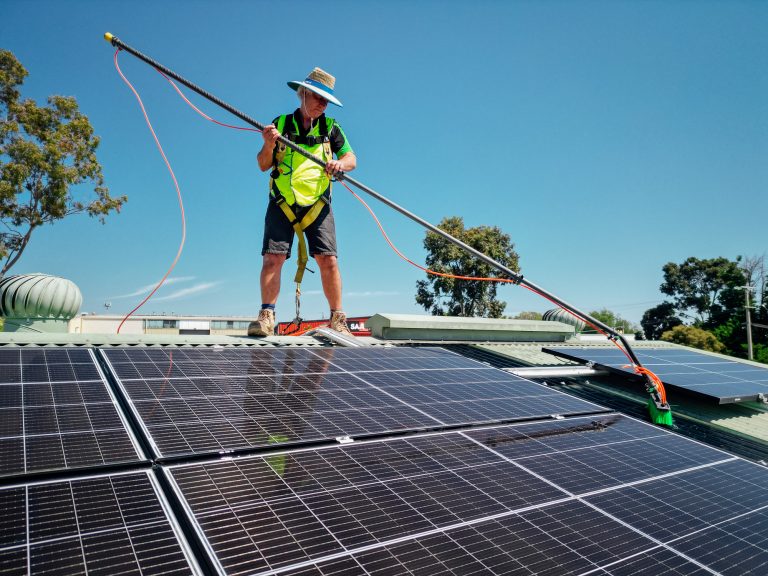
For homeowners looking for professional solar panel cleaning services that use appropriate technique and materials for their specific environmental conditions, the solar panel cleaning page provides information on what a professional service in a demanding environment should involve.
Environmental conditions affect solar panel performance more than expected because the gap between Standard Test Conditions and Australian real-world operating conditions is significant and consistent. Temperature derating, diverse soiling types, UV-induced material degradation, thermal cycling stress, and coastal corrosion all operate simultaneously and cumulatively across a system’s operating life. Homeowners who understand these factors can interpret their monitoring data more accurately, maintain their systems more effectively, and set realistic performance expectations that account for the environment in which their panels actually operate.