If you live within a few kilometres of the ocean and have steel gutters, you have probably noticed that they seem to deteriorate faster than those on inland properties of a similar age. That observation is not imagination. Coastal environments genuinely accelerate metal corrosion in ways that are measurable, well-documented, and directly relevant to how you maintain and manage the gutters on your home.
Understanding why rust forms faster in coastal gutters, what the mechanisms are, and what can be done about it helps homeowners make better decisions about maintenance frequency, material selection, and when repair or replacement becomes the more sensible option.
Rust is the result of an electrochemical reaction between iron, oxygen, and water. Steel gutters contain iron, and rain provides both water and dissolved oxygen. In an inland environment, the rate at which this reaction proceeds is governed primarily by how long the gutter surface stays wet after rainfall and whether any protective coating is compromised.
In a coastal environment, a third significant factor enters the equation: chloride ions from salt air. Chloride ions do not cause rust directly, but they dramatically accelerate the electrochemical process that does. Understanding why starts with how protective coatings on steel gutters actually work.
Most steel gutters sold in Australia use zinc-based protective coatings, either galvanising or Zincalume, to prevent the underlying steel from being exposed to moisture. Zinc is a more reactive metal than iron, which means it corrodes preferentially in a process called cathodic protection. As long as the zinc coating remains intact, the steel beneath is protected.
The zinc coating is not permanent. UV exposure, physical abrasion, the acidic compounds in leaf debris, and normal weathering all degrade it over time. Once the coating is compromised at any point, the iron is exposed, and the rust process begins at that location.
Salt in marine air is sodium chloride. When it deposits on a gutter surface and absorbs atmospheric moisture, it dissociates into sodium and chloride ions. Chloride ions are particularly damaging to metal surfaces because they penetrate through microscopic imperfections in protective coatings and attack the zinc layer beneath.
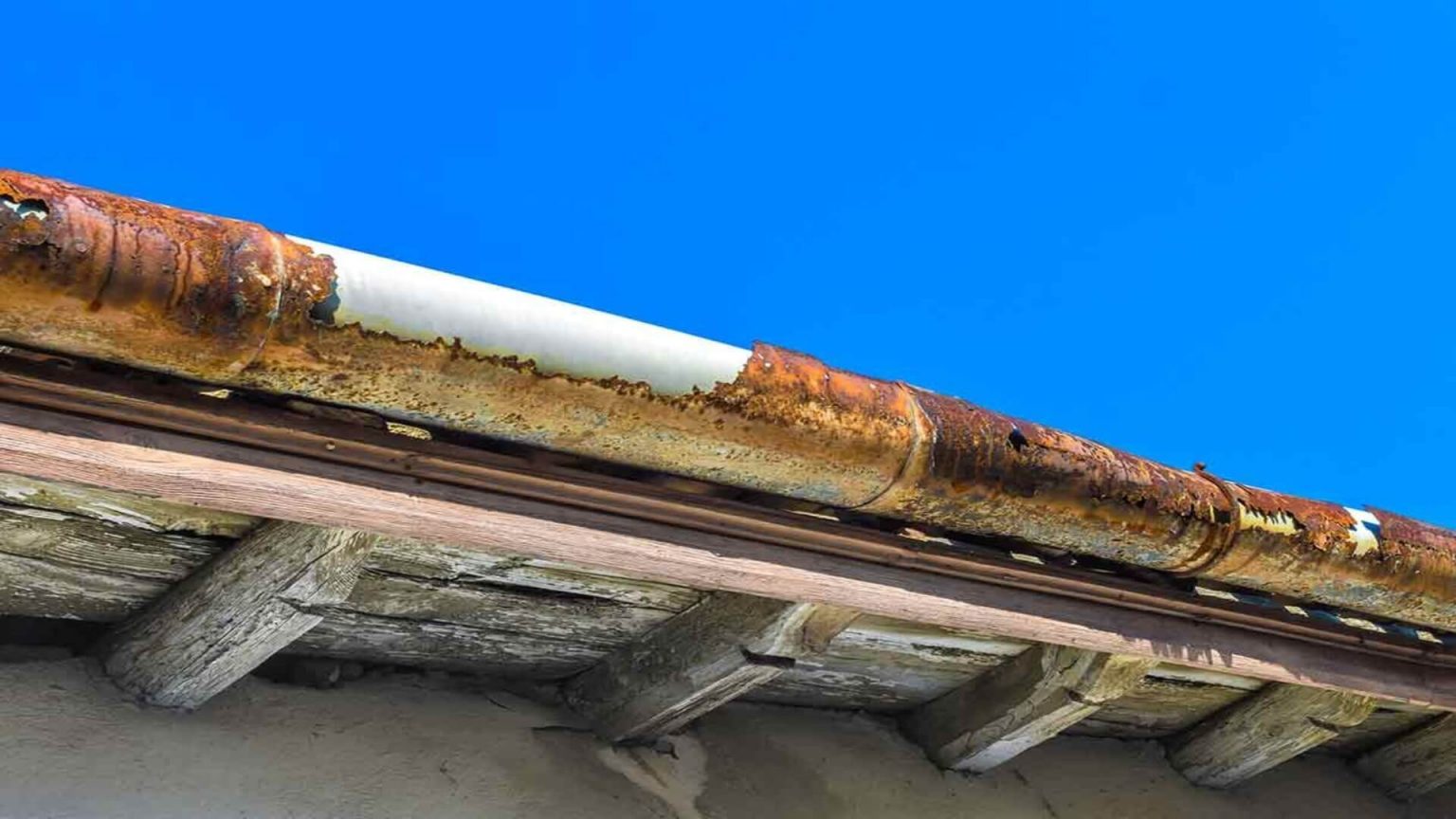
This penetration capability means that chloride ions can initiate corrosion at points where the coating appears visually intact. The corrosion begins below the surface, where it is not visible, and only becomes apparent when the underlying rust has expanded enough to lift or blister the coating above it. By the time rust staining is visible on a coastal gutter, the actual corrosion has typically been progressing for months.
Salt dissolved in water creates an electrolyte, a solution that conducts electrical current. The electrochemical corrosion reaction that rusts steel requires an electrolyte to proceed. In dry conditions, the reaction is slow because even if water is present, it lacks conductivity without dissolved minerals. Salt water is an efficient electrolyte, which means the corrosion current flows faster, the reaction proceeds more rapidly, and rust forms at a rate that can be several times faster than in equivalent conditions without the salt.
This is why the same gutter material and the same coating, installed on a home two kilometres from the ocean versus twenty kilometres inland, can show dramatically different corrosion rates within five to ten years of installation.
Several factors specific to the seaside environment combine to produce the accelerated corrosion rates that coastal homeowners observe.
Unlike a single rainfall event that wets a gutter and then dries, coastal salt air deposits chloride continuously, day and night, regardless of weather conditions. Prevailing onshore winds carry salt particles inland and deposit them on all surfaces, including gutter channels. In calm conditions, deposition rates are lower. During strong onshore winds, the salt load on exposed surfaces can be substantial.
Properties within five hundred metres of the ocean or open bay, or on headlands and elevated blocks with unobstructed exposure to sea breezes, experience the highest deposition rates. Properties two to three kilometres inland from the coast still experience measurably higher salt deposition than fully inland locations, which is why the corrosion effect is relevant across a broader coastal band than many homeowners appreciate.
Gutters in coastal areas experience the same wet-dry cycling as those inland, but each wetting event reactivates the salt deposits that accumulated during the preceding dry period. A gutter surface that carries a layer of salt residue from several weeks of dry coastal weather, then receives rainfall, is immediately exposed to a concentrated salt solution rather than clean water.
This wet-dry cycling with salt reactivation means that every rain event is more corrosively active than the equivalent event would be on an inland gutter. The corrosion rate during each wet period is higher, and because coastal regions often have shorter dry periods due to higher humidity and sea spray, the frequency of these events is also greater.
Inland gutters dry relatively quickly after rain, which limits the period during which active corrosion is occurring. Coastal environments maintain higher ambient humidity levels, which slows the drying of gutter surfaces after rainfall and can prevent complete drying altogether during humid summer periods.
A gutter that remains damp for twelve hours after rain has twelve hours of active corrosion. A gutter that dries completely within two hours has a fraction of that exposure. In humid coastal Queensland, New South Wales, and Western Australian coastal zones, gutters may remain at elevated humidity levels for extended periods, significantly extending the active corrosion window.
Leaf litter, bark, and organic debris in a coastal gutter holds moisture against the gutter surface long after the surrounding air has dried. This debris layer acts as a poultice, concentrating moisture and any dissolved salts at the gutter base and preventing the surface from drying between events.
The combination of salt-laden debris and the prolonged moisture contact it creates at the base of the gutter channel is one of the most aggressive corrosion environments that residential gutter materials encounter. Corrosion at the base of a coastal gutter that is regularly carrying debris accumulation can progress to perforation in a fraction of the time it would take in a clean, debris-free channel.
The cumulative effect of the factors above means that gutter material selection and maintenance frequency need to be calibrated differently for coastal properties than for inland ones.
Not all gutter materials respond equally to the coastal environment. Understanding the relative performance of common materials helps homeowners make informed decisions about replacement products.
Standard galvanised steel, which was the dominant material in Australian residential construction until the 1980s, offers limited corrosion resistance in coastal environments. The zinc coating is susceptible to chloride penetration, and once compromised, the underlying steel rusts quickly.
Zincalume, which combines zinc, aluminium, and silicon in its coating alloy, offers significantly better corrosion resistance than standard galvanised steel. The aluminium component provides better barrier protection and the alloy coating is more resistant to chloride penetration than pure zinc.
Colorbond steel, which adds a polymer paint layer over the Zincalume substrate, provides additional barrier protection and is the standard recommendation for coastal environments in Australia. The paint layer prevents direct salt contact with the metal coating and, as long as it remains intact, significantly slows the corrosion initiation process.
Aluminium gutters are naturally more corrosion-resistant than steel products in coastal environments because aluminium forms a stable, self-repairing oxide layer on its surface. However, aluminium is not immune to corrosion in marine environments and can experience pitting corrosion in high-chloride conditions over extended periods.
For coastal gutters showing active rust, the decision between repair and replacement depends on whether the corrosion is superficial or has progressed to through-wall perforation. Surface rust that has not yet perforated the gutter wall can sometimes be arrested and treated to extend service life. Once perforation has occurred, the structural and drainage integrity of the affected section is compromised, and replacement is generally the more appropriate response.
In coastal areas, the relevant question for older steel gutters is not just the cost of repair but how much additional service life a repair is likely to provide. A repair on a gutter that has extensive coating failure across the run may buy one to two seasons before the next section fails. Replacing the run with a material appropriate for coastal conditions provides a long-term solution rather than an extended repair cycle.
Prevention is significantly more cost-effective than replacement for coastal gutter systems. The following approach addresses the primary mechanisms of accelerated coastal corrosion.
When gutters require replacement in a coastal environment, specify Colorbond steel or aluminium rather than standard galvanised profiles. The additional cost of these materials over their service life is substantially lower than the accelerated replacement cycle that standard steel produces in coastal conditions.
For properties in high-exposure coastal zones, specifically those within five hundred metres of open water or on elevated, wind-exposed blocks, aluminium is worth considering even at its higher upfront cost due to its superior long-term corrosion resistance.
In a coastal environment, the debris-as-poultice effect means that regular gutter cleaning is more important than in inland areas. Removing debris from the gutter channel reduces the period during which salt-laden moisture is held in concentrated contact with the gutter base. For most coastal properties, this means cleaning at a higher frequency than the two-per-year standard that suits many inland homes.
Professional gutter cleaning that removes all compacted debris from the channel, including material at downpipe entries, is the most effective way to remove the moisture-retaining layer that accelerates base corrosion. A clean that leaves compacted material at the base of the channel has not addressed the primary corrosion site.
Annual inspection of gutter surfaces, looking for paint blistering, rust staining, discolouration, or surface pitting, allows early-stage corrosion to be identified and treated before it progresses to structural failure. Treatment options for early-stage corrosion include rust-converting primers and compatible topcoat applications that can extend the service life of the gutter when applied before perforation occurs.
The brackets and screws that attach gutters to fascia boards are also subject to accelerated corrosion in coastal conditions. Corroded fixings lose load-bearing capacity, which leads to gutter sagging and eventually to sections pulling away from the fascia. Checking fixing integrity annually and replacing corroded hardware before it fails is a straightforward preventative measure.
For more articles on gutter maintenance, material performance, and related topics for Australian homeowners, the Gutter Gorilla blog covers a wide range of practical guidance across different climate regions and property types.
Coastal gutters rust faster because the environment they operate in is genuinely more corrosive than inland conditions. The combination of chloride deposition, electrolyte-enhanced corrosion reactions, extended surface wetness, and debris moisture retention creates an accelerated deterioration pathway that standard maintenance frequencies and material choices do not always account for adequately. Homeowners who understand the mechanisms, choose appropriate materials, and maintain more frequently than inland benchmarks suggest are the ones who get the most value from their gutter systems before replacement becomes necessary.